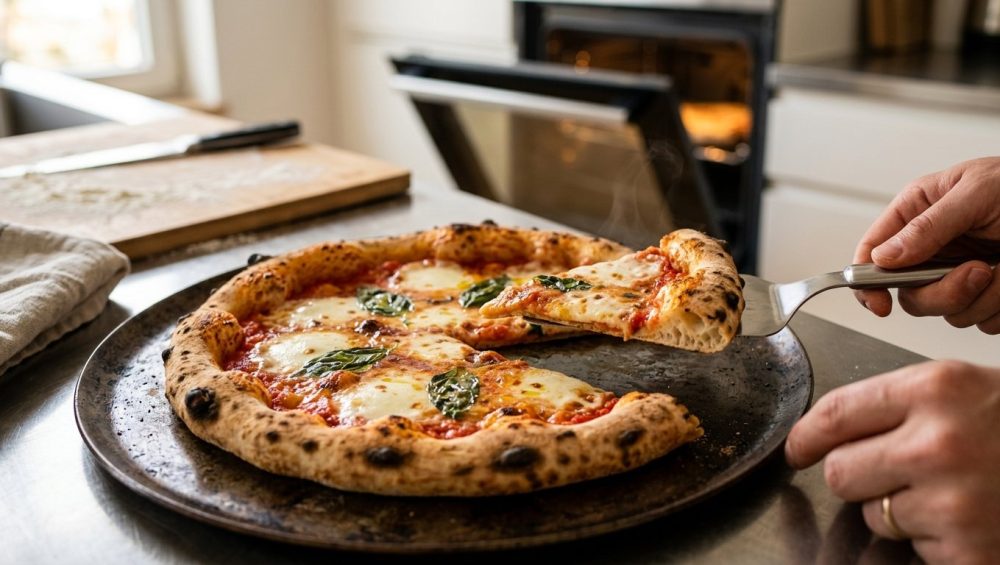
Picture this: It is Friday night. You have spent the entire week surviving on thirty-minute meals and clever weekday shortcuts so that you could dedicate your precious weekend to a true culinary project. You mixed the flour, you kneaded the dough, and you patiently let it cold-ferment in the fridge for seventy-two hours to develop that complex, artisanal flavor. You splurged on the good San Marzano tomatoes and the fresh, milky mozzarella. You slide your beautiful, handcrafted masterpiece into your 500-degree home oven, wait fifteen minutes, and pull it out.
The cheese is perfectly melted, bubbling, and golden. The basil smells intoxicating. You slice into it, lift a piece, and… disaster strikes. The tip immediately droops. The toppings slide off in a sad, greasy avalanche. You flip the slice over, and there it is: a pale, flabby, pathetic, soggy bottom.
Listen up, folks. I have been there. I have set off my smoke detector a few too many times, and I have eaten more than my fair share of mediocre, floppy homemade pizza. If you are serious about breaking your takeout habit, you need to understand that this failure is not your fault. It is not your dough recipe, it is not your sauce-to-cheese ratio, and it is certainly not a lack of culinary talent.
The culprit is physics. Specifically, it is the fundamental thermodynamic limitations of a standard residential home oven. Today, we are going to ditch the pretentious chef-speak and dive deep into the science of thermal conductivity. We are going to explore why traditional baking methods fail you, why cheap gear is ruining your food, and how a heavy-duty slab of carbon steel is going to permanently revolutionize your pizza game.
The Science of the Slice: Thermodynamics for the Home Cook
To understand why your pizza is soggy, we first have to understand what your home oven is actually doing—and more importantly, what it is failing to do. Blaming your recipe instead of your equipment is one of those rookie kitchen mistakes that keeps enthusiastic home cooks stuck in a cycle of frustration. You do not need a culinary degree to make mind-blowing food, but you do need to understand how heat works.
The Home Oven Disadvantage: Air is a Terrible Conductor
Authentic Neapolitan pizzerias use massive, refractory brick wood-fired ovens that operate at blistering temperatures of 800°F to 900°F. At these extreme temperatures, a pizza cooks in roughly sixty to ninety seconds. The intense, stored heat in the floor of the oven instantly sears the bottom of the dough, while the ambient heat radiating from the dome cooks the top.
Your home oven, on the other hand, likely maxes out at 500°F or 550°F. But the temperature is only half of the problem; the real issue is the medium of heat transfer. When you bake a pizza on a standard aluminum baking sheet or directly on the oven rack, you are relying heavily on the hot air inside the oven to cook the dough.
Here is the brutal truth: air is a spectacularly terrible conductor of heat. Think about it this way—you can comfortably reach your bare hand into a 400°F oven for a few seconds to grab a roasting pan without sustaining an injury. The 400°F air does not transfer its heat into your skin fast enough to burn you immediately. However, if you were to touch the 400°F metal oven rack with your bare hand, you would suffer a severe burn instantly. The temperature is exactly the same, but the rate of heat transfer is vastly different.
When your wet, room-temperature pizza dough is placed into a 500°F oven, the hot air simply cannot deliver energy fast enough to evaporate the moisture and crisp the bottom before the cheese on top overcooks and turns into a rubbery mess. The result is the dreaded “gum line”—a layer of dense, unbaked dough sitting right beneath your sauce.
Heat Capacity vs. Thermal Conductivity (The Nerd Stuff, Simplified)
To solve the soggy bottom crisis, we have to introduce a baking surface into the oven that can store a massive amount of heat and deliver it into the dough violently and rapidly. This brings us to two critical concepts: heat capacity and thermal conductivity.
Thermal conductivity measures how fast a material can transfer heat. A material with high thermal conductivity acts like a wide-open floodgate, allowing thermal energy to rush out of it and into your food.
Heat capacity (or thermal mass) refers to how much total thermal energy a material can store. If thermal conductivity is the floodgate, heat capacity is the size of the reservoir behind it. You need a material that has a massive reservoir of heat and the ability to dump that heat into your pizza dough the millisecond it makes contact. When wet dough hits a highly conductive, high-mass surface, the water at the interface flashes into steam immediately. This violent burst of steam creates micro-air pockets in the dough, leading to rapid starch gelatinization, structural crispness, and that beautiful, airy “oven spring”.
The False Prophet: Why Traditional Ceramic Pizza Stones Fail You
For decades, the culinary industry sold home cooks a lie. We were told that the ultimate secret to replicating pizzeria-quality crust at home was to buy a ceramic or cordierite pizza stone. The logic seemed sound: professional pizza ovens are made of stone and brick, so putting a piece of stone in your home oven should yield the same results, right? Wrong.
The Slow Transfer of Heat
Ceramic and cordierite stones are excellent insulators, but they are incredibly poor conductors of heat. The thermal conductivity of a standard cordierite pizza stone is a measly 1.5 to 3 W/m·K,. While a thick stone can eventually store a decent amount of heat, it is incredibly stingy about giving that heat up.
When you slide a cold, wet pizza onto a pre-heated ceramic stone, the stone transfers its heat into the dough at a sluggish pace. Because the heat transfer is so slow, the moisture in the dough has time to pool and steam gently rather than flashing aggressively. This is why ceramic stones often yield a crust that is “biscuity,” pale, or leathery, rather than shatter-crisp and blistered.
Furthermore, because the stone is a poor conductor, it suffers from terrible thermal recovery times. When the cold dough hits the stone, the surface temperature of the stone plummets. A standard ceramic stone can take anywhere from four to six minutes to recover its peak temperature after a pizza is launched. If you are hosting a pizza night and trying to bake three or four pies back-to-back, the second and third pizzas are going to be significantly paler and soggier than the first, because the stone simply has not had time to recharge its thermal battery.
The Inevitable Crack of Doom
Aside from their mediocre baking performance, ceramic stones possess a fatal, heartbreaking flaw: they are fragile. Cordierite and ceramic are highly vulnerable to thermal shock. If any moisture from your sauce spills over the edge of the dough, or if you place a slightly too-cold dough onto a blazing hot stone, the rapid localized temperature change causes the material to expand and contract unevenly.
Just like that time your glass baking dish shattered after a sudden temperature change, your beloved pizza stone will eventually betray you with a loud, depressing pop, splitting right down the middle. I have lost count of how many expensive ceramic stones I have had to throw into the garbage after they cracked during a Friday night pizza session. We demand durability in our kitchens, and ceramic stones simply do not deliver.
The Toxic “Crisper” Pan Trap: A Warning
Before we introduce the ultimate solution, we need to have a serious talk about the absolute worst piece of equipment you could possibly use. As your resident sassy sous-chef, I have a strict, uncompromising “No-Go” rule when it comes to toxic gear. I absolutely despise cheap, peeling non-stick coatings, and I will not let you ruin your health or your food with them.
If you wander into any big-box store, you will find cheap, flimsy aluminum pizza pans covered in tiny holes, marketed as “crisper pans.” They are almost always coated in polytetrafluoroethylene (PTFE), commonly known as Teflon. Do not buy these. If you already own one, throw it in the recycling bin immediately.
Here is the terrifying science: PTFE non-stick coatings are fundamentally unstable at high temperatures. While they are generally safe for low-to-medium heat cooking, PTFE begins to rapidly degrade and decompose when it reaches temperatures around 500°F (260°C),. When heated above 662°F (350°C), the coating breaks down entirely, releasing invisible, highly toxic gaseous compounds and fine particles into your kitchen air,. Inhaling these fumes causes a documented medical condition known as “polymer fume fever” or the “Teflon flu,” which induces severe shivering, fever, sore throat, and coughing. It is also notoriously lethal to pet birds.
This is the exact same reason your cheap pans keep losing their slip after a few months of searing steaks—high heat utterly destroys the chemical integrity of the coating. To make a great pizza, your oven needs to be set to its absolute maximum temperature (usually 500°F to 550°F), and the pan will absorb radiant heat that pushes its surface temperature even higher. Placing a PTFE-coated pan into a 500°F oven is not just a recipe for a terrible, soggy pizza; it is actively dangerous,. Before you go complaining that your favorite pan lost its non-stick magic, evaluate the extreme temperatures you are exposing it to. We only use safe, high-quality, durable equipment in this kitchen.
Enter the Baking Steel: The Heavy-Metal Hero of Homemade Pizza
If ceramic stones are fragile and slow, and non-stick pans are toxic and useless, what is the home cook to do? The answer lies in a heavy, industrial, indestructible slab of metal: the Baking Steel.
What Exactly Is a Baking Steel?
A baking steel is exactly what it sounds like: a precision-cut, heavy-duty plate of food-grade carbon steel (typically A36 alloy) designed to replace a traditional pizza stone,. They are usually a quarter-inch to three-eighths of an inch thick, and they weigh anywhere from fifteen to twenty-five pounds,.
The concept was pioneered and brought to the mainstream in 2012 by Andris Lagsdin, a former restaurant cook who had spent time working on the management team for Chef Todd English,. Frustrated by the pale, soggy pizzas his home oven kept producing, Lagsdin was reading an interview with food scientist Nathan Myhrvold about the monumental cookbook Modernist Cuisine. A single line in the article struck him like lightning: “Steel conducts heat better than stone.”.
Lagsdin, whose family happened to run the Stoughton Steel Company in Massachusetts, grabbed a scrap piece of quarter-inch carbon steel from his dad’s manufacturing shop, took it home, and baked a pizza on it,. The results were instantly staggering—a beautifully charred, blistered, pizzeria-quality crust baked in a standard residential oven. He launched the Baking Steel on Kickstarter in August 2012, caught the attention of culinary heavyweights like Kenji López-Alt, and completely revolutionized the landscape of home pizza making,.
The Unmatched Thermal Conductivity of Carbon Steel
The magic of the baking steel comes down to raw, unfiltered thermodynamics. Much like the reason your fried rice is always mushy (a severe lack of sustained, intense heat), pizza dough needs a violent blast of energy to properly crisp.
Carbon steel possesses a thermal conductivity rating of roughly 43 to 54 W/m·K,. Compare that to the 1.5 to 3 W/m·K of a cordierite stone,. This means that a baking steel conducts heat into your pizza dough a staggering eighteen to thirty-six times faster than a ceramic stone,.
While steel has a slightly lower specific heat capacity than stone by weight, its extreme density (7.85 g/cm³) means that it stores significantly more thermal energy per square inch,. When your cold dough hits the scorching hot steel, the heat transfer is so rapid and aggressive that it mimics the thermal environment of a 900-degree commercial brick oven. The moisture in the dough instantly flashes to steam, creating massive, airy bubbles in the crust and a deeply browned, leopard-spotted undercarriage.
Furthermore, the thermal recovery time of steel is unparalleled. Because it is so conductive, it pulls heat from the ambient oven air aggressively. A baking steel can recover its peak surface temperature in just 75 to 90 seconds after a pizza is loaded, compared to the agonizing four to six minutes required by a stone,. You can bake pie after pie, and the fourth pizza will be just as shatter-crisp as the first.
The Indestructible Nature of Steel (Say Goodbye to Thermal Shock)
Let us not forget my favorite feature of the baking steel: it is practically indestructible. You can drop it on the floor (though your floor will certainly lose that battle), you can blast it under a screaming hot broiler, and you can throw ice-cold dough onto it without a second thought. Carbon steel does not care about thermal shock. It will never crack, it will never split, and it will outlive you, your children, and your grandchildren. It is a true buy-it-for-life kitchen tool.
How to Actually Use Your Baking Steel for Pizzeria-Quality Crust
Owning a baking steel is only half the battle; knowing how to wield it is what separates the weekend warriors from the true home-kitchen artisans. You cannot just throw the steel into a cold oven, turn it on, and immediately toss a pizza inside. We need to respect the thermal battery.
The Pre-Heat Protocol: Patience Yields Blisters
Because the steel is so dense, it takes time to fully saturate with thermal energy. Place your baking steel on a rack in the upper third of your oven. Turn your oven to its absolute highest baking setting—usually 500°F or 550°F.
Once your oven beeps to tell you it has reached the target temperature, do not put the pizza in. The air in the oven has reached 500°F, but that massive slab of steel has not. You must let the steel preheat for an absolute minimum of forty-five to sixty minutes,. This hour-long preheat is non-negotiable. It is the time required to fill the thermal reservoir so that it can dump all that glorious heat into your crust.
The Launch: Semolina, Peels, and Overcoming Fear
If you are still furiously googling why your DIY pizza sticks to the peel right before launch, you need to refine your mechanics. Building a pizza on a hot steel requires a pizza peel. I highly recommend using a wooden peel for launching the raw dough, as wood absorbs excess moisture and prevents sticking, and a thin metal peel for retrieving the finished, cooked pie.
Dust your wooden peel generously with semolina flour—not regular all-purpose flour, which burns easily and turns bitter. Semolina acts like tiny ball bearings, allowing the dough to glide effortlessly. Build your pizza quickly on the peel. Do not let it sit there for ten minutes while you chat with your guests, or the moisture from the sauce will seep through the dough and glue it to the wood. Give the peel a gentle shimmy to ensure the dough is loose, open the oven door, angle the peel downward toward the back of the hot steel, and smoothly pull the peel back to drop the pizza.
The Broiler Trick: Faking a 900-Degree Wood-Fired Oven
Because the steel conducts heat so rapidly, the bottom of your pizza is going to cook exceptionally fast—often in just four to six minutes. However, the top of your pizza is still relying on the relatively poor heat conductivity of the 500°F oven air to melt the cheese and blister the crust edges.
To prevent the bottom from burning before the top is finished, we use the broiler trick. About two minutes before the pizza is done, switch your oven from “Bake” to “Broil.” This activates the upper heating element, blasting the top of the pizza with intense, direct radiant heat. This perfectly mimics the rolling flames across the dome of a commercial wood-fired oven, giving you beautifully charred bubbles on the crust and perfectly caramelized cheese.
Maintenance: Caring for Your Heavy Metal
Caring for carbon steel is incredibly straightforward. It uses the exact same principles as seasoning cast iron to maintain its surface and prevent rust. Because it is raw, uncoated steel, it is susceptible to oxidation if left wet.
When you are done baking, let the steel cool completely in the oven. Once cool, use a stiff bench scraper to chip off any burnt cheese or semolina dust. Wipe it down with a dry or very slightly damp cloth. If you need to wash it, dry it immediately and thoroughly, then rub a microscopic drop of neutral cooking oil (like canola or grapeseed) over the surface to protect it from moisture. Over time, your shiny silver steel will develop a dark, beautiful, naturally non-stick patina.
Beyond Pizza: The Unexpected Versatility of Your Baking Steel
While the baking steel was born out of a desire for the perfect slice, it is far from a unitasker. Because it is essentially a massive, highly conductive griddle, it unlocks a whole new world of culinary possibilities in your home kitchen.
If you are frustrated by the fact that your thin aluminum baking sheets keep warping under the broiler, the baking steel is your salvation. You can place the steel directly on your stovetop burners (if you have gas or induction) and use it as a massive plancha. It is the ultimate surface for making diner-style smashed burgers, achieving an edge-to-edge crust on a seared ribeye steak, or frying up a massive batch of weekend bacon and eggs.
For the bakers out there, the steel is a revelation for rustic artisan breads. The intense bottom heat provides explosive oven spring for sourdough boules, ciabatta, and baguettes. It is also phenomenal for baking English muffins, blistering fresh pita bread in seconds, or creating perfectly crisp roasted vegetables,.
Even when you are not actively cooking on it, the baking steel improves your oven. By leaving the heavy slab of steel permanently on the bottom rack of your oven, it acts as a thermal regulator. It absorbs heat and minimizes the aggressive temperature fluctuations that naturally occur as your oven cycles on and off, leading to more even, consistent baking for everything from delicate layer cakes to braised short ribs.
The Verdict: A Lifetime Investment in Crust Perfection
Yes, a high-quality, three-eighths-inch thick baking steel is heavy. It requires two hands to move, and it is more of an investment than a cheap, flimsy aluminum pan. But as I always tell my readers, we do not waste our money on garbage that we have to replace every six months. We buy smart, we buy safe, and we buy for life.
The baking steel is not just a pizza accessory; it is a fundamental upgrade to the physics of your home oven. It is a heavy-duty, heirloom-quality tool that earns its permanent place in any beautifully organized dream kitchen.
Stop settling for pale, flabby, soggy-bottomed pizzas. Stop throwing away cracked ceramic stones. Stop poisoning your air with overheated non-stick pans. Embrace the science of thermal mass, invest in a slab of carbon steel, and prepare to ruin your local delivery place for good. You have the skills, you have the passion, and now, you finally have the thermodynamics on your side. Now go preheat your oven—we have some blistering to do.