Listen up. If you are reading this, you have probably set off your smoke detector one too many times this week, stared blankly into your refrigerator hoping a Michelin-starred meal would magically assemble itself, or spent way too much of your paycheck on yet another lukewarm takeout delivery. I get it. I have been there. Before I figured out how to actually run my kitchen, my kitchen ran me. But here is the brutal, unvarnished truth: absolutely anyone can cook like an expert. You do not need a culinary degree, you do not need to speak fluent French, and you certainly do not need a kitchen that looks like a sterile laboratory. You just need a little bit of science, a few decent tools, and the willingness to stop making the same easily preventable errors.
I am not here to tell you a whimsical, meandering story about how my grandmother used to forage for wild truffles in the hills of Tuscany. You do not have time for that, and frankly, neither do I. You are here because it is a Tuesday night, you are staring at a rock-hard frozen chicken breast, and you are strongly considering eating a bowl of cereal for dinner. Put down the cereal box. We are going to fix this. This entire guide is dedicated to transforming your daily cooking from a stressful chore into kitchen artistry.
The Reality Check: Why You Are Struggling (And Why It Is Not Your Fault)
The Myth of the 30-Minute Meal
Let’s dismantle the biggest lie perpetuated by glossy food magazines and cheerful television chefs: the effortless 30-minute meal. When a recipe claims it takes thirty minutes, they are assuming you have the knife skills of a seasoned line cook and an invisible prep team who has already washed, peeled, and perfectly measured your ingredients into adorable little glass bowls. For a beginner, a 30-minute recipe is often a 75-minute recipe. Do not beat yourself up when you are still chopping onions at the 40-minute mark. Speed comes with repetition, not from rushing.
The “Less Time Than Ever” Epidemic
I am not just giving you a free pass to feel better about yourself; the data explicitly backs this up. We are currently living through a severe time deficit. According to recent 2025 and 2026 culinary surveys, a staggering 60% of young adults report feeling they have less time than ever before to cook a proper meal at home. The average time spent preparing dinner plummeted to just under 31 minutes in 2025. Nearly half of Gen Z and millennials admit to having under half an hour on a standard weeknight to get a meal on the table.
Furthermore, young adults are spending an eye-watering average of $19,890 annually on food, heavily skewed toward takeout and delivery. Yet, 80% of these same individuals state they do not cook as often as they would like to, citing a lack of foundational cooking knowledge as the primary barrier. It is no wonder that when you are exhausted from a brutal commute and the endless professional grind, convenience usually wins. But convenience does not have to mean a sad, sodium-bomb microwave dinner or a $35 delivery fee for cold fries.
Purging the Poison: The Non-Negotiable Rule on Cookware
The 2026 PFAS Reckoning
Before we chop a single vegetable, we need to have a serious talk about the toxic wasteland currently residing in your cabinets. I have absolutely zero patience for cheap, peeling non-stick pans. You know the ones I am talking about—the scratched-up, warped skillets you bought for fifteen bucks five years ago that are currently flaking mystery chemicals into your scrambled eggs. This isn’t just me being a pretentious cookware snob; it is a legitimate, documented health hazard.
In fact, 2026 is the year the government finally agreed with me. Starting January 1, 2026, states like Washington, Colorado, and Maine have implemented sweeping bans on consumer products containing “intentionally added” PFAS (per- and polyfluoroalkyl substances, widely known as “forever chemicals”), explicitly targeting cookware. New York, Minnesota, and others are following closely behind with strict reporting and phase-out laws. If state governments are literally outlawing the sale of these pans because they are toxic, why are you still cooking your family’s dinner on them? Throw them away. Today. Do not donate them; throw them in the trash.
Safe Alternatives That Won’t Poison Your Dinner
You do not need a 14-piece matching set of pots and pans. You need a few high-quality, durable pieces. If you want to stop wasting money on gimmicks, stick to the kitchen essentials every beginner needs that will actually last.
- Stainless Steel: The workhorse of the professional kitchen. Yes, it requires you to actually learn how to control your heat so food doesn’t stick (we will cover the Leidenfrost effect later), but it is indestructible, non-toxic, and creates the best pan sauces.
- Cast Iron: Your grandmother was right. A well-seasoned cast-iron skillet is naturally non-stick, fortifies your food with trace amounts of iron, and can go directly from the stovetop into a 500-degree oven. It will outlive you if you simply dry it after washing and rub a little oil on it.
- Enameled Cast Iron/Ceramic: If you must have a non-stick surface for delicate items like eggs or fish, look for high-quality enameled cast iron or 100% ceramic-coated pans that explicitly state they are PFAS, PTFE, and PFOA-free.
The Modern Arsenal: Appliances That Actually Earn Their Counter Space
The Air Fryer: More Than a Glorified Microwave
Let’s talk about modern convenience. The air fryer is not a passing fad; it is a weekday survival tool. The global air fryer market is projected to hit $1.32 billion in 2026, with North America leading the charge. In the UK, over 53% of households that own an air fryer cite cost-efficiency and lower energy usage as their primary reasons for using it over a traditional oven.
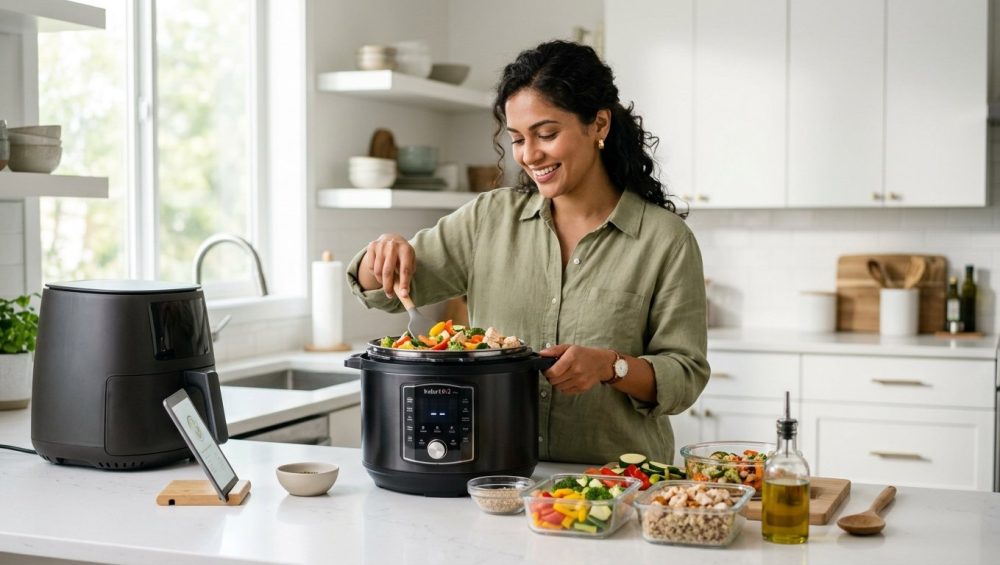
An air fryer is essentially a high-powered, compact convection oven that sits on your countertop. It circulates screaming-hot air around your food, reducing cooking times by up to 30% and achieving crispy textures with a fraction of the oil. However, you need to use it correctly. Stop overcrowding the basket. If you stack raw chicken wings on top of each other, they will steam, not fry. Cook in batches, and shake the basket halfway through. Also, manufacturers are finally getting the memo on toxicity—2026 models are heavily emphasizing rapid-heat technology paired with PFAS-free ceramic coatings.
The Multicooker: The Weekday Savior
The multicooker (like the Instant Pot) is the ultimate cheat code for tough cuts of meat and dried beans. It is a programmable electric pressure cooker that forces moisture and heat into your food rapidly. A pork shoulder that takes eight hours in a slow cooker can be rendered fall-apart tender in 45 minutes under high pressure. It is the perfect appliance for the “set it and forget it” mentality required on a Wednesday evening.
The Essential Hand Tools
You do not need a drawer full of single-use, plastic gadgets like avocado slicers, strawberry hullers, or garlic presses that are impossible to clean. It is entirely possible to start with a modest collection of beginner kitchen tools you actually need and still produce restaurant-quality food. You need three things to start:
- An 8-inch Chef’s Knife: Spend your money here. A sharp knife is a safe knife. A dull knife requires you to apply excessive force, which is how you end up in the emergency room.
- A Heavy Wooden Cutting Board: Toss those flimsy plastic mats that slide around your counter. You need a solid, heavy block that stays put.
- A Bench Scraper: The cheapest, most versatile tool in your kitchen. Use it to scoop up chopped vegetables, clean off your cutting board, and divide dough.
Once you have the basics down, you can start investing in the must-have tools for the culinary curious, like an immersion blender or a digital meat thermometer (which, shockingly, only 43% of Gen Z currently owns).
Weekday Warfare: Ruthless Efficiency and Hacks
The Art of the Shortcut
Time is money, and on a Tuesday at 6:30 PM, time is everything. We are rigorously prioritizing efficiency here. The global meal prep market size hit a massive $36.4 billion in 2026, driven by the simple fact that urban professionals are working 40+ hour weeks and are desperate for ready-to-eat solutions. Approximately 46% of urban consumers now rely heavily on meal prep options.
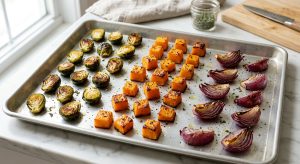
There is absolutely no shame in utilizing shortcuts. Buy the pre-washed spinach. Buy the minced garlic in a jar if it means you will actually cook instead of ordering a $40 pizza. Batch-cook your grains (rice, quinoa, farro) on Sunday so you only have to microwave them on Wednesday. Roast a massive tray of vegetables at the beginning of the week and toss them into salads, wraps, or pasta as the week progresses.
Adapting Traditional Recipes for Modern Tech
You do not need to buy a specific “Air Fryer Cookbook.” You can adapt almost any traditional oven recipe to your modern appliances with a few simple math formulas:
- Oven to Air Fryer: Reduce the suggested oven temperature by 25°F (or roughly 15°C) and cut the cooking time by 20%. Keep a close eye on it during the last few minutes, as the aggressive convection fan browns food very quickly.
- Slow Cooker to Pressure Cooker (Multicooker): If a recipe calls for 8 hours on “Low” in a slow cooker, it generally translates to about 30 minutes on “High Pressure” in a multicooker, followed by a natural pressure release. Make sure you add at least one cup of thin liquid (like broth or water) so the machine can actually build pressure.
Weekend Perfectionism: Taking Your Time When It Counts
Embracing the Process
While Monday through Friday is about survival and speed, the weekend is your time to slow down. This is when you ditch the shortcuts. This is when you mince your own garlic, simmer a homemade stock for hours, and actually enjoy the tactile process of cooking. Weekends are your opportunity to craft simple meals for mindful moments without the ticking clock of a weekday schedule. Pour yourself a glass of wine, put on a playlist, and treat cooking as a creative outlet rather than a chore.
Elevating the Basics
Weekend cooking is about taking simple, high-quality ingredients and treating them with respect. You do not need to make a complicated beef wellington to impress yourself. When you have the time to slow down, mastering a dish like pan-seared salmon and asparagus is incredibly rewarding. Focus on achieving that perfectly crisp, golden-brown skin on the fish, and snapping the woody ends off the asparagus so they roast to tender-crisp perfection. It is about technique over complexity.
The Core Techniques Every Beginner Must Master
I see people making the same rookie kitchen mistakes every single day, and it breaks my heart. Let’s fix your foundation.
Knife Skills 101
Stop holding your chef’s knife by the handle like you are gripping a tennis racket. You need to use the “pinch grip.” Pinch the base of the metal blade (the bolster) between your thumb and index finger, and wrap your remaining three fingers loosely around the handle. This gives you infinitely more control and balance.
Your non-dominant hand—the one holding the food—must form a “claw.” Tuck your fingertips inward, resembling a bear claw, and use your knuckles as a guide for the side of the knife blade. If your fingertips are tucked away, you physically cannot chop them off. It is that simple.
Heat Control and the Maillard Reaction
If your food looks pale, gray, and sad, you are failing at heat control. The “Maillard reaction” is the chemical reaction between amino acids and reducing sugars that gives browned food its distinctive, complex flavor. It is the reason a seared steak tastes infinitely better than a boiled one.
To achieve this, your pan must be hot, and your food must be dry. Water is the enemy of browning. Pat your proteins completely dry with a paper towel before they hit the pan. If you are using a stainless steel skillet, use the “water droplet test” (the Leidenfrost effect): heat the dry pan over medium heat, then drop a tiny bead of water into it. If the water sizzles and evaporates immediately, the pan is not hot enough. If the water bead forms a perfect sphere and glides around the pan like a mercury marble, your pan is perfectly preheated. Add your oil, then add your food. It will not stick.
Seasoning Like You Mean It
Most home cooks chronically under-season their food. If you follow a recipe perfectly and the end result tastes “flat” or “boring,” you do not need more herbs; you need salt and acid.
- Salt: Salt does not just make food salty; it amplifies the natural flavors of the ingredients. Season your food at every stage of the cooking process, not just at the end.
- Acid: This is the secret weapon of professional chefs. If a heavy stew, a rich pasta sauce, or a roasted vegetable dish feels like it is missing something, hit it with a splash of acid. A squeeze of fresh lemon juice, a dash of apple cider vinegar, or a few drops of balsamic will instantly brighten the dish and cut through the richness.
Organizing for Success: Your Kitchen is a Workshop
The Zone System
You cannot move quickly if you do not have a permanently organized kitchen. Treat your kitchen like a professional workshop. Establish dedicated zones: a prep zone (where your cutting board and knives live), a cooking zone (near the stove, housing your oils and spatulas), a washing zone (sink, sponges, dish rack), and a storage zone.
Adopt the French culinary concept of mise en place (everything in its place). Before you turn on a single burner, read the recipe all the way through, chop all your vegetables, measure out your spices, and have your ingredients staged and ready to go. Trying to frantically chop an onion while your garlic is actively burning in the skillet is a guaranteed path to a ruined dinner.
Keeping it Bright and Spacious
A cluttered, dark kitchen is a depressing place to work, and it will subconsciously deter you from wanting to cook. Even in a tiny apartment, there are clever ways to make your kitchen feel brighter and more spacious. Clear your countertops of appliances you use less than once a week. According to surveys, items like waffle makers and ice cream machines are used less than once a year by the vast majority of Americans. Put them in a closet. Your counter space is premium real estate; reserve it for your cutting board, your chef’s knife, and your daily drivers like the coffee maker and the air fryer.
Entertaining Without the Meltdown
The Casual Dinner Party
When you finally decide to host a relaxed dinner party, you shouldn’t be sweating over the stove with a look of sheer panic in your eyes when your guests arrive. Entertaining is supposed to be fun, not a high-stakes theatrical performance.
The golden rule of dinner parties is the “Rule of Three.” Never plan a menu that requires you to actively cook more than one component at the last minute. Your menu should consist of:
- One thing made entirely ahead of time (e.g., a cold appetizer, a salad, or a dessert that has been chilling in the fridge since yesterday).
- One thing that passively cooks in the oven or slow cooker (e.g., a braised roast, baked potatoes, or a casserole).
- Only one thing that requires active stovetop attention right before serving (e.g., searing the protein or tossing the pasta in its sauce).
Effortless Hosting
Do not apologize for the food. If the chicken is slightly overcooked, do not announce it to the table. Most people are just thrilled that someone else cooked for them and poured them a glass of wine. Dim the lights, put on a great playlist, and focus on the conversation. The energy of the host dictates the energy of the room. If you are stressed, your guests will be stressed. If you are laughing, drinking wine, and casually pulling a beautiful (if slightly imperfect) meal out of the oven, your guests will have an incredible time.
Final Thoughts from the Sous-Chef
Cooking is not magic. It is a highly learnable skill built on a foundation of basic techniques, proper heat management, and the right tools. Stop letting the kitchen intimidate you. Throw out your toxic pans, sharpen your chef’s knife, embrace the weekday shortcuts, and give yourself the grace to mess up a few times.
You are going to burn a piece of toast. You are going to over-salt a soup. It happens to literally everyone. But the more you practice, the more intuitive it becomes, until one day you realize you aren’t just following recipes anymore—you are actually cooking. Now go preheat your pan, dry off your proteins, and make something amazing for dinner tonight. You’ve got this.