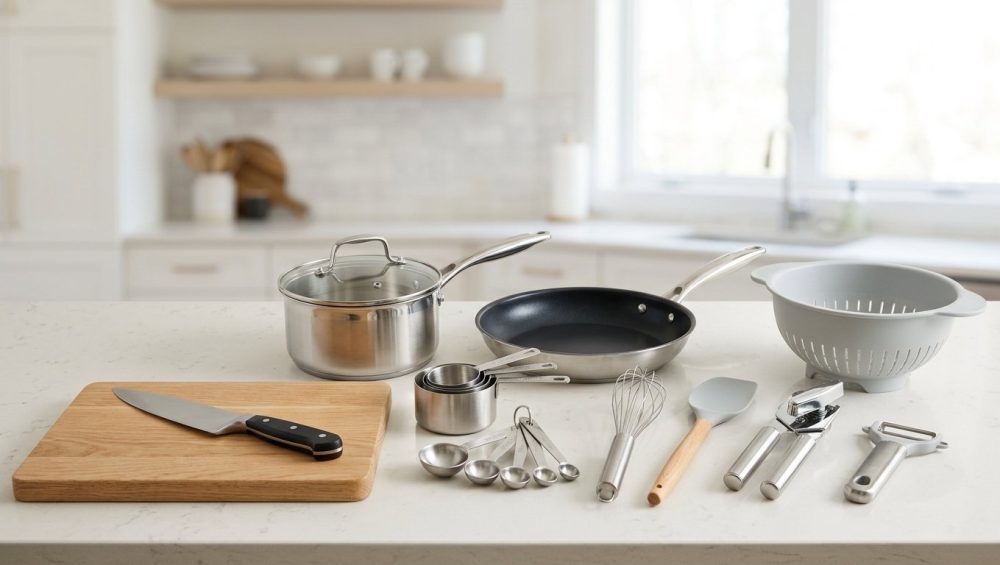
Welcome to your kitchen. If you are standing in the middle of it right now, staring at a chaotic jumble of mismatched spatulas, a dull knife you bought at a grocery store in 2019, and a frying pan with a peeling coating that looks like it survived a localized apocalypse, take a deep breath. We are going to fix this.
According to recent industry data from the 2025-2026 State of Home Cooking report, a staggering 93% of Americans expect to cook at home as much as, or more than, they did last year. Why? Because the economy is squeezing our wallets (cited by 85% of people), we are trying to reclaim our health (81%), and frankly, almost half of us (49%) are carrying around a heavy dose of guilt every time we order overpriced, lukewarm takeout.
But here is the unfiltered truth: cooking at home is only a miserable, time-consuming chore if you are fighting your equipment. You do not need a culinary degree from Le Cordon Bleu to make mind-blowing food. You do not need a kitchen that looks like a sterile laboratory, and you certainly do not need a gadget for every hyper-specific task (I am looking at you, single-use avocado slicers). What you do need is a curated arsenal of high-quality, reliable tools that do the heavy lifting for you.
As a busy professional who learned to cook through sheer stubbornness, trial, error, and setting off the smoke detector more times than I care to admit, I have zero patience for pretentious chef-speak or useless kitchen clutter. On a Tuesday night, time is money. We need efficiency. On a Saturday afternoon, we have the luxury of time to be perfectionists. But regardless of the day of the week, I have one absolute, non-negotiable rule: No toxic trash. We do not cook with cheap, peeling, chemical-laden mystery metals. We invest in safe, durable gear that will last a lifetime.
Consider this your definitive, no-fluff masterclass on setting up your first kitchen. Let’s get to work.
The Foundation: Knives That Actually Cut
If I walk into your kitchen and see a massive, 15-piece wooden knife block taking up half your counter space, I will judge you. You do not need 15 terrible knives; you need three excellent ones. A dull knife is the most dangerous object in your kitchen because it requires you to use excessive force, which inevitably leads to slipping and a trip to the emergency room.
The Chef’s Knife: Your Kitchen Extension
The 8-inch chef’s knife is the absolute workhorse of the kitchen. It should feel like a natural extension of your hand. You will use this blade for 90% of your cutting tasks: breaking down poultry, dicing onions, mincing garlic, and chopping root vegetables.
When choosing a chef’s knife, you generally have two styles to consider: Western (German) and Japanese. Western knives are heavier, feature a thicker blade, and are made from slightly softer steel (usually around 56-58 on the Rockwell hardness scale), making them incredibly durable and forgiving for beginners who might accidentally hit a bone. Japanese knives are lighter, thinner, and made from harder steel (60-62 HRC), which allows for razor-sharp precision but requires more careful handling.
If you are a beginner on a budget, the undisputed champion of the entry-level market in 2026 is the Victorinox Fibrox Pro 8-Inch Chef’s Knife. It is the darling of professional kitchens worldwide because it features high-quality Swiss steel, takes an edge beautifully, and has an indestructible, ergonomic, slip-resistant plastic handle. It usually retails for under $60 and performs like a knife triple its price.
If you have a bit more cash to spend and want a knife that will last decades, look at the Wüsthof Classic 8-Inch. It is a forged German blade with a full tang (meaning the metal extends all the way through the handle), offering perfect balance and heft for rock-chopping.
For those who want the ultimate hybrid—the precision of a Japanese blade with the durability of a Western knife—the MAC Professional Series 8-Inch (MTH-80) is widely considered by experts in 2025 and 2026 to be the best overall chef’s knife on the market. It is lightweight, blisteringly sharp out of the box, and features dimples to prevent food from sticking.
The Paring Knife and The Serrated Knife
Your chef’s knife needs two sidekicks. First, a 3-to-4-inch paring knife. You use this for off-board, in-hand work where an 8-inch blade would be clumsy and terrifying. Think peeling apples, hulling strawberries, or meticulously mincing a single shallot. You do not need to spend a fortune here; a simple $10 Victorinox paring knife will outlive us all.
Second, you need a 9-to-10-inch serrated knife (often called a bread knife). A straight-edge chef’s knife will crush a crusty loaf of sourdough or butcher a ripe tomato. The teeth of a serrated knife act like a saw, biting through tough exteriors without squishing the delicate interior. Because serrated knives are notoriously difficult to sharpen, treat them as a budget item you replace every five to ten years.
Cutting Boards: Protect Your Blades and Your Gut
Let me be perfectly clear: if you own a glass or marble cutting board, throw it in the recycling bin immediately. Cutting on glass or stone will instantly destroy the microscopic edge of your chef’s knife, turning a $150 blade into a useless piece of scrap metal in minutes.
You need boards that are soft enough to absorb the impact of the knife but hard enough to resist deep gouges where bacteria can throw a microscopic rave. According to the United States Department of Agriculture (USDA), your best options are solid wood, bamboo, or non-porous plastic (like high-density polyethylene). Bamboo is highly recommended because it absorbs very little moisture, resists scarring, and is naturally harder than many hardwoods.
For weekday sanity and food safety, you must practice separation to avoid cross-contamination. The USDA strongly advises using one cutting board exclusively for raw meat, poultry, and seafood, and a separate board for fresh produce and breads. I recommend a heavy, thick wooden or bamboo board for your vegetables, and a plastic board with a juice groove for your meats, because plastic can be thrown directly into the dishwasher.
To sanitize any board (wood or plastic) after dealing with raw chicken, the USDA recommends a mixture of one tablespoon of unscented liquid chlorine bleach per gallon of water. Flood the surface, let it sit for a few minutes, rinse thoroughly with clear water, and let it air dry.
Pots and Pans: The “No Toxic Trash” Zone
We need to have a serious talk about the cookware industry, because it has been lying to you for decades.
The Scam of Traditional Non-Stick Cookware
If your kitchen cabinets are full of lightweight, scratched-up, peeling black non-stick pans, you are playing a dangerous game with your health. Traditional non-stick coatings are made using PFAS (per- and polyfluoroalkyl substances), a massive family of thousands of synthetic chemicals. You might see pans proudly labeled “PFOA-free,” but do not be fooled by this marketing sleight of hand. While PFOA was phased out due to severe toxicity concerns, manufacturers simply replaced it with other PFAS chemicals, most commonly PTFE (Polytetrafluoroethylene, widely known by the brand name Teflon).
Recent 2025 and 2026 data is alarming. A global survey found that 79% of tested non-stick pans were coated with PTFE. These are “forever chemicals,” meaning they do not break down in the environment or in your body. The Environmental Protection Agency (EPA) and leading scientific research have linked PFAS exposure to a terrifying laundry list of health issues, including increased risks of kidney and testicular cancers, liver damage, thyroid disease, immune system suppression, and interference with natural hormone regulation.
When you heat a PTFE-coated pan past 500°F (260°C)—which happens incredibly fast if you preheat an empty pan on a gas stove—the coating begins to degrade on a molecular level, releasing toxic, invisible fumes. Furthermore, the moment you scratch that coating with a metal spatula, you are inviting microplastics and forever chemicals directly into your scrambled eggs.
Traditional non-stick pans are disposable garbage. They have a lifespan of roughly 3 to 5 years before the coating inevitably fails. Stop wasting your money and poisoning your food. If you absolutely must have a manufactured non-stick pan for delicate items like fish or eggs, buy a high-quality, third-party certified ceramic-coated pan (which uses a sand-based sol-gel coating instead of PFAS), never use metal utensils on it, and never heat it past medium. But honestly? You don’t even need that.
Carbon Steel and Cast Iron: The True Non-Stick
Instead of toxic chemicals, we use science and fat. Cast iron and carbon steel skillets develop a natural, non-toxic, non-stick surface through a process called “seasoning”—which is simply oil that has been heated past its smoke point until it polymerizes, bonding to the metal and forming a slick, protective layer.
You need a 10-inch or 12-inch Cast Iron Skillet. It is heavy, it takes a while to heat up, but once it gets hot, it stays hot. This thermal mass makes it the ultimate tool for searing a steak to a mahogany-brown crust or shallow-frying chicken. With proper care, a cast iron pan will literally last for generations.
If cast iron is too heavy for your weekday wrist, buy a Carbon Steel Skillet. It is the darling of restaurant kitchens. It seasons exactly like cast iron, but it is lighter, responds to temperature changes much faster, and has sloped sides that allow you to toss vegetables like a pro. Once a carbon steel pan is well-seasoned, you can fry a delicate egg on it and it will slide around like it’s on an ice rink.
The Stainless Steel Sauté Pan and Skillet
If cast iron is for searing and carbon steel is for eggs, what is stainless steel for? Everything else. Specifically, it is for building flavor through the Maillard reaction (the browning of proteins) and creating pan sauces.
When you sear a piece of chicken in a stainless steel pan, little browned bits of caramelized protein stick to the bottom. In the culinary world, this is called fond, and it is pure, concentrated flavor. You deglaze the pan with a splash of wine or chicken broth, scrape up those bits with a wooden spoon, add a knob of butter, and suddenly you have a restaurant-quality pan sauce in three minutes. You cannot do this in a non-stick pan because the fond never forms; it just burns or washes away.
You want a 10-inch or 12-inch fully clad stainless steel skillet. “Fully clad” or “tri-ply” means the pan is constructed with a core of highly conductive metal (like aluminum or copper) sandwiched between layers of durable stainless steel. Stainless steel on its own is a terrible conductor of heat, but when wrapped around an aluminum core, it heats evenly across the entire base and up the sides, eliminating hot spots that burn your food.
The Dutch Oven and The Saucepan
For boiling, simmering, and braising, you need vessels with volume.
First, a 3-to-4-quart stainless steel saucepan. This is your weekday workhorse for boiling pasta water for two, making a batch of rice, reducing a sauce, or reheating soup. Again, look for fully clad construction so your rice doesn’t scorch to the bottom.
Second, the undisputed king of weekend cooking: the 5.5-to-7-quart Enameled Cast Iron Dutch Oven. This is a heavy cast iron pot coated in a smooth, non-reactive glass enamel. You use this for slow-cooking stews, braising short ribs, making massive batches of chili, or baking crusty artisan bread. The heavy lid traps moisture, and the cast iron walls radiate gentle, even heat from all directions when placed inside an oven. It is an investment piece (brands like Le Creuset or Staub will run you a few hundred dollars, though Lodge makes excellent budget alternatives), but it will outlive you.
Prep Tools: Saving Your Weeknight Sanity
Cooking on a Tuesday night after a nine-hour workday is an exercise in crisis management. If your prep takes too long, you will give up and order a pizza. These tools buy you time.
The Mighty Microplane
If you buy only one gadget from this entire article, make it a Microplane classic zester/grater. Originally designed as a woodworking tool, it is the secret weapon for injecting massive amounts of flavor into your food with zero knife skills required.
Instead of spending five minutes meticulously mincing garlic cloves into sticky, uneven chunks, you can grate them on a Microplane in ten seconds to create a fine paste that melts instantly into your sauces. Use it to zest lemons, limes, and oranges (which contains the fruit’s essential oils, offering pure flavor without the sour acidity of the juice). Use it to grate fresh ginger without dealing with the fibrous strings. Use it to shower a mountain of fluffy, cloud-like Parmesan cheese over your pasta. It costs $15 and will change your life.
Mixing Bowls and Measuring Gear
You need a set of nesting mixing bowls. Buy stainless steel or tempered glass. Do not buy plastic mixing bowls. Plastic is porous; it will absorb the garlic vinaigrette you made on Monday and aggressively transfer that flavor to the brownie batter you mix on Friday. Stainless steel is lightweight, unbreakable, and perfect for tossing salads or marinating meats.
When it comes to measuring, you need standard measuring spoons (1/4 tsp, 1/2 tsp, 1 tsp, 1 Tbsp) and liquid measuring cups. But if you have any intention of baking, or if you want to follow modern recipes accurately, you must buy a Digital Kitchen Scale.
Volume measurements (cups) are notorious liars. A “cup of flour” can weigh anywhere from 100 grams to 150 grams depending on how aggressively you scooped it, whether the flour was compacted, or the humidity in the room. A 50-gram difference in flour is the difference between a light, tender cake and a dense, dry brick. Grams do not lie. A digital scale that measures in grams is precise, eliminates the need to wash six different measuring cups, and makes baking an exact science rather than a stressful guessing game.
The Salad Spinner
I used to think salad spinners were bulky, unnecessary contraptions—until I realized why my homemade salads tasted like watery sadness. Oil and water do not mix. If you wash your lettuce and do not dry it completely, the water clinging to the leaves will repel your vinaigrette. The dressing will pool at the bottom of the bowl, leaving you eating bland, wet foliage. A salad spinner uses centrifugal force to strip every drop of water from your greens. Bonus: the basket doubles as a colander for draining pasta, and the outer bowl can be used as a serving dish.
Utensils: The Unsung Heroes of the Line
You do not need a countertop crock stuffed with 40 different spatulas. You need four specific tools to manipulate your food with precision.
The Silicone Spatula
Throw away your cheap rubber or plastic spatulas. They melt, they stain, and they leach chemicals into your hot food. You need a seamless, one-piece silicone spatula. Silicone is heat-resistant up to 600°F. You can use it to scramble eggs directly in a hot pan, scrape every last drop of batter out of a bowl, or fold delicate whipped cream. Because it is seamless, there is no hidden crevice where the handle meets the head for bacteria to hide.
Spring-Loaded Tongs
Tongs are your heat-proof hand extensions. You need two pairs of heavy-duty, stainless steel, spring-loaded tongs: a 9-inch pair for precision work (flipping chicken breasts, tossing pasta in sauce) and a 12-inch pair for reaching into a hot oven or managing a splattering skillet. Skip the ones with silicone tips unless you are exclusively cooking on delicate ceramic pans; bare metal tips offer a much more secure grip on heavy cuts of meat.
The Fish Spatula (Metal Turner)
The standard, thick plastic pancake flipper is a blunt instrument. You need a slotted metal fish spatula. Despite the name, it is not just for fish. It features a thin, flexible, angled stainless steel head with a razor-thin edge. This allows you to slide smoothly under a delicate fried egg, a fragile piece of cod, or a smash burger without tearing the crust you worked so hard to build. The slots allow excess oil to drain away. It is the most versatile turner in the kitchen. (Note: Do not use this on enameled cast iron or ceramic pans, as it will scratch them. Use it on your bare cast iron, carbon steel, and stainless steel).
The Wooden Spoon
There is a reason the wooden spoon has been a culinary staple for centuries. Wood is an insulator, meaning the handle won’t get blazing hot if you leave it resting against the edge of a simmering pot. It is firm enough to scrape up fond from the bottom of a stainless steel pan, but soft enough that it will never scratch your cookware. Buy a flat-edged wooden spoon (sometimes called a wooden turner); the flat edge makes contact with more surface area of the pan, making deglazing a breeze.
Appliances: What You Actually Need (And What’s Just Counter Clutter)
Counter space is premium real estate. Do not clutter it with single-use appliances like quesadilla makers or electric egg cookers. Invest in versatile machines that drastically reduce your active prep time.
The Immersion Blender
Transferring boiling hot soup from a Dutch oven into a countertop blender is a high-risk operation that usually ends with third-degree burns and a kitchen covered in tomato puree. An immersion blender (or stick blender) solves this. You plug it in, submerge the wand directly into your pot, and blend your soups, sauces, or refried beans right where they are cooking. It is also the ultimate tool for making foolproof, two-minute homemade mayonnaise or emulsifying a broken vinaigrette. When you are done, the wand detaches and rinses clean in ten seconds.
The Food Processor vs. The Blender
People often confuse the roles of these two machines. A high-speed countertop blender (like a Vitamix or Ninja) requires liquid to function properly. It creates a vortex that pulls food down into the blades. It is designed for smoothies, silky purees, and frozen drinks. A food processor, on the other hand, is a mechanized prep chef. It has a wide, flat bowl and does not require liquid. You use a food processor to rapidly chop a mountain of onions, blitz graham crackers into crust, knead pizza dough in 60 seconds, or use the attachment discs to shred a block of cheddar cheese in the blink of an eye. If you cook more savory meals than you drink smoothies, prioritize the food processor.
The Multicooker (Instant Pot)
Remember the rule: time is money on weekdays. An electric multicooker (widely popularized by the Instant Pot brand) is a programmable pressure cooker that manipulates the boiling point of water, allowing you to cook food at incredibly high temperatures without drying it out.
It turns a tough, cheap cut of pork shoulder into fall-apart pulled pork in 45 minutes instead of 4 hours. It cooks dried black beans from scratch (no soaking required) in under an hour. It makes perfect, peel-able hard-boiled eggs and flawless rice. For the home cook trying to get a nutritious, complex-tasting dinner on the table by 7:00 PM on a Wednesday, the pressure cooker is a non-negotiable asset.
Baking Basics for the Weekend Perfectionist
Even if you don’t consider yourself a “baker,” you are going to roast vegetables, bake chicken thighs, and occasionally make chocolate chip cookies. You need the right hardware.
Aluminum Half-Sheet Pans
Do not buy those flimsy, dark-coated, non-stick baking sheets from the grocery store. Dark metals absorb heat aggressively, which will burn the bottoms of your cookies before the tops are cooked. Furthermore, cheap pans warp with a loud “BANG!” in a hot oven, sending your perfectly arranged asparagus rolling into a pile.
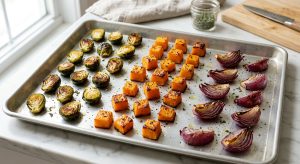
You need commercial-grade, heavy-gauge bare aluminum half-sheet pans (18 by 13 inches). Aluminum is a phenomenal heat conductor, ensuring even baking. They have rolled, encapsulated steel rims that prevent warping at high temperatures. They are cheap, indestructible, and the backbone of the trendy “sheet pan dinner.”
Wire Cooling Racks
A sheet pan is only half of the equation. You need a stainless steel wire cooling rack that fits perfectly inside your half-sheet pan.
Yes, you use this to cool cookies so air can circulate underneath them, preventing soggy bottoms. But its true power lies in savory cooking. If you place a steak or a chicken on a wire rack set inside a sheet pan and leave it in the fridge overnight, the cold air circulates entirely around the meat, drying out the surface (a process called dry-brining). A dry surface is the absolute prerequisite for a spectacular, restaurant-quality sear. Furthermore, roasting bacon or chicken wings on a wire rack allows the rendered fat to drip away, leaving you with impossibly crispy skin rather than meat boiling in its own grease.
Conclusion: Time to Get Cooking
Setting up a kitchen can feel like navigating a minefield of marketing gimmicks, toxic materials, and overpriced gadgets. But if you adhere to the fundamentals—prioritizing durable materials, respecting food safety, and rejecting the false convenience of chemical non-stick coatings—you will build an environment where cooking is a joy, not a burden.
You don’t need to buy all of this tomorrow. Start with a Victorinox chef’s knife, a heavy wooden cutting board, and a solid stainless steel skillet. Learn how to hold the knife. Learn how to heat the pan. Make mistakes, burn a few onions, and figure out how to salvage a pan sauce.
The culinary world wants you to believe that great food is locked behind the doors of Michelin-starred restaurants. It isn’t. The magic happens in standard home kitchens, on Tuesday nights, armed with nothing but a sharp blade, a hot pan, and the confidence to use them. Now, pour yourself a glass of wine, turn on some music, and go chop an onion. You’ve got this.