Picture this: You’ve invited a few friends over for a chic, Japanese-inspired summer dinner. You’ve curated the perfect lo-fi playlist, poured the crispest Junmai sake, and confidently walked out of the kitchen carrying a beautiful ceramic bowl of chilled soba noodles. You set it down, hand your guest a pair of chopsticks, and watch in sheer horror as they attempt to pick up a single strand—only to lift an entire, solid, beige brick of glued-together carbohydrates. The bowl practically levitates off the table.
Congratulations. You have just served a soba loofah.
Welcome back to my kitchen, where we fix the culinary crimes that are quietly ruining your dinner parties. If you’ve ever wondered why your cold buckwheat noodles turn into a gelatinous, impenetrable mass five minutes after you boil them, you are not alone. And more importantly, it is entirely preventable.
The global pasta and noodles market is an absolute juggernaut, estimated at nearly $88 billion in 2024. But within that massive sea of instant ramen and boxed spaghetti lies the refined, artisanal world of soba. Soba is elegant, earthy, and deeply historic, but it is also incredibly unforgiving if you treat it like a box of cheap macaroni.
Today, we are going to dive deep into the food science of starch gelatinization, the absolute necessity of the ice-water rinse, and how to properly build a stress-free, interactive cold noodle bar. Because let’s be brutally honest: nobody wants to spend their Saturday night sweating over a rolling boil while their guests drink all the good wine in the living room. You deserve to host with elegance, and your friends deserve noodles that don’t require a steak knife to separate. Consider this your essential kitchen survival guide for mastering the art of the Japanese noodle.
The Anatomy of Soba (Or, Why Buckwheat is a High-Maintenance Diva)
Before we can fix the clump, we have to understand what we are actually cooking. Soba is not standard pasta. In fact, its primary ingredient isn’t even technically wheat.
Buckwheat (Fagopyrum esculentum) is a pseudocereal, a broadleaf plant more closely related to rhubarb and sorrel than to the golden fields of wheat used to make your standard linguine. Buckwheat cultivation in Japan dates back over 6,600 years, but the long, slender noodles we recognize today became a cultural phenomenon during the Edo period, originally starting as a Zen Buddhist ritual food.
When you shop for soba, you will generally encounter two main categories, and knowing the difference is crucial to your success:
Juwari Soba (The Purist’s Choice)
Juwari soba is made from 100% buckwheat flour and water. Because buckwheat contains absolutely zero gluten, there is no natural elastic protein network to hold the dough together. Making Juwari soba by hand requires a master’s touch to prevent the dough from crumbling into dust. When cooked, these noodles have a profound, nutty, earthy flavor and a highly brittle, delicate texture. They are magnificent, but they are also incredibly fragile and prone to breaking if you look at them wrong.
Ni-Hachi Soba (The Home Cook’s Best Friend)
Also known as Hachi-wari, this is the standard soba you will find in most grocery stores. It translates to “two-eight,” representing a ratio of 20% wheat flour to 80% buckwheat flour. The addition of wheat introduces gluten into the mix, providing the structural integrity needed for a smoother, chewier noodle that can survive the boiling process without disintegrating. For everyday cooking and hosting, this is the noodle you want in your pantry.
The Science of the Clump: Why Your Noodles Turn to Glue
If you treat soba like Italian pasta, you will fail. It is that simple.
When you cook Italian pasta, you are relying on the surface starches released into the boiling water to help bind your tomato or cream sauces to the noodle. You are actively encouraged to save that murky, starchy pasta water to emulsify your sauces.
Soba operates in an entirely different culinary universe. To understand why your soba clumps, we have to look at the microscopic structure of buckwheat starch. Buckwheat starch granules are incredibly fine, averaging between 2 and 9 micrometers in size. Because they are so small, they possess a massive surface area, making them highly efficient at absorbing water.
The Gelatinization Process
When you drop dried soba into boiling water, the heat and moisture trigger a process called starch gelatinization. For buckwheat, this onset of gelatinization begins at around 57.8°C to 64.3°C (roughly 136°F to 147°F). The microscopic starch granules absorb the boiling water, swell up like tiny water balloons, and eventually burst.
When they burst, they expel two types of starch molecules—amylose and amylopectin—directly into the cooking water and onto the surface of the noodles. This creates a highly sticky, viscous coating on the exterior of every single strand.
If you simply drain your soba in a colander and leave it on the counter, that sticky surface starch rapidly cools. As it cools, the starch molecules undergo retrogradation, realigning and crystallizing into a solid gel. In plain English: the noodles literally glue themselves together into a solid brick.
The Masterclass Technique: The Sacred Starch Rinse
To prevent the dreaded clump, we must physically remove that gelatinized starch from the surface of the noodles before it has a chance to set. This is not an optional step. This is the entire secret to making perfect soba. You cannot skip this, you cannot rush this, and you certainly cannot do this half-heartedly.
Step 1: The High-Volume Boil
Do not try to boil soba in a tiny saucepan. You need a massive pot of rapidly boiling water. The sheer volume of water provides the thermal mass necessary to ensure the temperature doesn’t plummet when you add the cold, dried noodles. You want the water to return to a boil instantly to prevent the noodles from sitting in tepid water and turning to mush. Do not salt the water; authentic soba already contains enough sodium, and the dipping sauce will provide the seasoning.
Step 2: The Ice Bath Shock
Before the noodles even hit the boiling water, you must have an ice bath ready and waiting in the sink. The moment the noodles reach their optimal texture (usually exactly what the package timer dictates, down to the second), you must immediately transfer them to the ice bath. This rapid drop in temperature instantly halts the cooking process, preventing the interior of the noodle from becoming flabby.
Step 3: The Aggressive Agitation
This is where the magic happens. Submerge your hands into the ice water and physically wash the noodles. Do not be overly gentle. You need to rub the strands between your palms as if you were hand-washing a delicate silk scarf. You will immediately feel the water turn cloudy and slimy. That is the gelatinized starch leaving the surface of the noodle. Having a dedicated Japanese wash bowl with side-drainage slits makes this process incredibly efficient, allowing the starchy water to overflow while keeping the noodles safely contained. Keep rinsing under cold running water until the water runs crystal clear and the noodles feel slick, firm, and completely separate.
Step 4: The Final Drain
Lift the noodles out of the water and let them drain thoroughly. Any residual tap water will dilute your dipping sauce later, which is a culinary tragedy we want to avoid. Traditionally, the noodles are served on a zaru, a slotted bamboo mat that allows any remaining moisture to drip away from the noodles, ensuring they remain perfectly textured throughout the meal.
The “No-Go” Gear Rule: Equip Your Kitchen Safely
You know my strict philosophy: I have zero patience for cheap, toxic kitchen equipment that actively fights against you while you cook. You cannot expect professional results if you are boiling your food in a scratched, peeling pan that leaches mystery chemicals into your water. I am fully committed to banishing toxic kitchen gear from your home, and boiling noodles is no exception.
When you boil soba, you need a heavy-bottomed, uncoated stainless steel stockpot or a large enameled cast-iron Dutch oven. Do not use flimsy aluminum, and absolutely do not use a non-stick pot. The high heat required for a rolling boil is exactly why losing their slip and degrading is so common with cheap Teflon pans.
Furthermore, you need the right tools to retrieve those noodles quickly. Dumping a massive, heavy pot of boiling water into a tiny plastic colander in the sink is dangerous and inefficient. Instead, use a stainless steel spider skimmer to effortlessly fish the noodles directly out of the boiling water and transfer them straight into your waiting ice bath. Investing in a few high-quality, durable beginner kitchen tools will transform your cooking from a stressful chore into a seamless, enjoyable process.
Building the Mindful Cold Noodle Bar (Zaru Soba Style)
Now that we have mastered the science of the noodle itself, let’s talk about the real reason we are here: hosting.
The beauty of a cold soba meal—known as Zaru Soba—is that it is the ultimate prep-ahead dinner party concept. It is infinitely more elegant than ordering takeout, yet requires a fraction of the active cooking time of a heavy, hot meal. It completely eliminates the dreaded “host-trap” where you are stuck in the kitchen monitoring a simmering sauce while your guests mingle without you.
Setting up a relaxed DIY noodle bar allows your guests to customize their own flavor profiles. It creates an interactive, communal dining experience that feels sophisticated but requires zero culinary skill from your guests. It shares the same effortless, communal energy as hosting a mindful hand-roll night, but with significantly less chopping and rolling.
The Prep-Ahead Blueprint
To pull this off flawlessly, your timeline should look like this:
- Two Days Before: Make your Tsuyu (dipping sauce) and store it in the fridge. The flavors actually deepen and mature as they sit.
- The Morning Of: Prep all of your Yakumi (aromatics and toppings). Store them in airtight containers in the fridge.
- Ten Minutes Before Eating: Boil, shock, and rinse the soba noodles. Plate them on individual bamboo mats or a large communal platter.
That is it. You are done. You can now pour yourself a glass of sake and actually enjoy the company of the people you invited over.
The Tsuyu: Crafting the Liquid Gold
You cannot serve perfectly rinsed, artisanal buckwheat noodles and then ruin them by pouring a bottle of cheap, preservative-laden sauce over them. The dipping sauce, known as Tsuyu (or Mentsuyu), is the soul of the dish. It provides the umami, the salt, and the subtle sweetness required to balance the earthy flavor of the buckwheat.
Making your own Tsuyu is remarkably simple and elevates the entire meal. It consists of two main components:
Kaeshi (The Flavor Base)
Kaeshi is a concentrated mixture of high-quality Japanese soy sauce, mirin (sweet rice wine), and a touch of sugar. The secret to a phenomenal kaeshi is to gently heat the mirin and sugar first to burn off the raw alcohol, then add the soy sauce and bring it just to the brink of a simmer. You never want to aggressively boil soy sauce, as high heat destroys its delicate, volatile flavor compounds.
Dashi (The Umami Broth)
Dashi is the foundational stock of Japanese cuisine, typically made by steeping kombu (dried kelp) and katsuobushi (smoked, fermented bonito flakes) in water. It is liquid umami.
To create your final Tsuyu, you simply combine your aged kaeshi with your freshly made dashi. For cold Zaru Soba, the sauce should be highly concentrated, as it will naturally dilute slightly when the wet noodles are dipped into it. Serve the sauce ice-cold in individual small cups for each guest.
Yakumi: The Essential Aromatics and Toppings
If the noodles are the canvas and the Tsuyu is the paint, the Yakumi are the bright, vivid accents that bring the masterpiece to life. Yakumi translates roughly to “medicinal flavor,” referring to the historical use of aromatic herbs and spices to aid digestion and balance the palate.
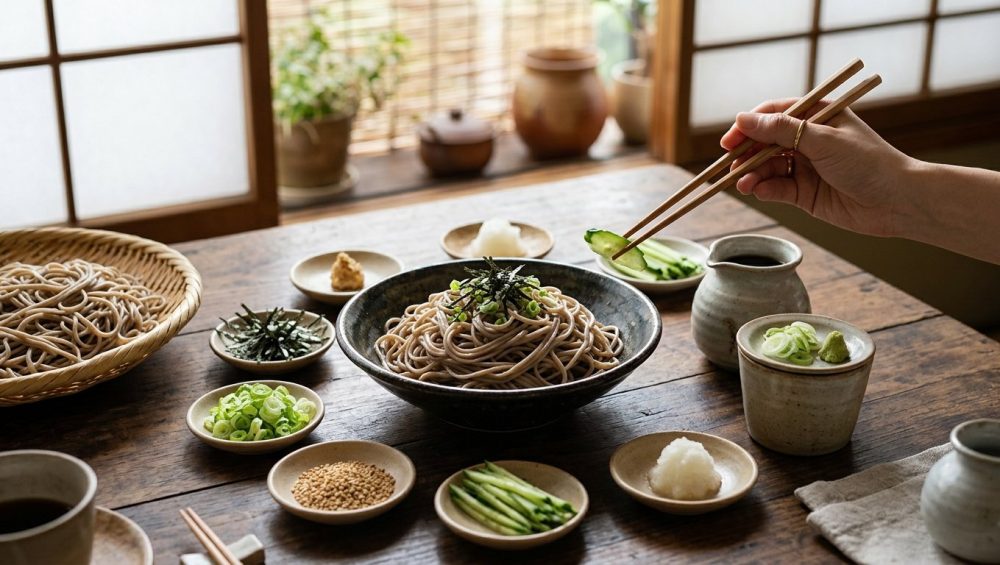
Providing a wide array of Yakumi is what transforms a simple bowl of noodles into an interactive, customizable feast. Arrange these in beautiful, small ceramic dishes in the center of the table and let your guests build their perfect bite.
The Core Aromatics
- Negi (Scallions): You want these sliced impossibly thin. A dull knife will crush the cellular walls of the scallion, releasing bitter sulfur compounds and leaving you with a bruised, pungent mess. Ensure your chef’s knife is razor-sharp. And please, use a proper wooden or rubber cutting board—using glass or hard bamboo is the fastest way of ruining your knives and making precision cuts impossible.
- Wasabi: If you can find fresh wasabi root to grate on a sharkskin paddle, you are a culinary hero. If not, a high-quality wasabi paste will suffice. Guests should dab a tiny amount directly onto the noodles, rather than dissolving it completely into the sauce, to preserve its bright, volatile heat.
- Grated Daikon Radish: Daikon provides a refreshing, peppery crunch that cuts through the rich umami of the dipping sauce. Grate it finely and gently squeeze out the excess water before serving.
- Kizami Nori: Finely shredded roasted seaweed adds a delicate ocean salinity and a beautiful visual contrast against the pale noodles.
The Proteins and Textures
To turn the noodle bar from a light appetizer into a filling main course, offer a few substantial side pairings:
- Tenkasu (Tempura Flakes): These crispy bits of fried tempura batter add an incredible textural crunch and a touch of richness to the cold dish.
- Chilled Proteins: Thinly sliced smoked duck breast, a perfectly jammy soft-boiled egg (Ajitsuke Tamago), or cubes of silken tofu are excellent, low-effort additions that keep the meal feeling substantial yet refreshing.
Troubleshooting Your Soba Disasters
Even with the best intentions, things can occasionally go sideways. If you find yourself staring at a less-than-perfect batch of noodles, here is how to diagnose the issue for next time:
The Noodles Are Mushy and Waterlogged
You either overcooked them, or you failed the ice bath shock. Soba cooks incredibly fast—often in under four minutes. If you walk away to check your phone, they are ruined. Furthermore, if your ice bath was just cool tap water, it didn’t drop the core temperature of the noodle fast enough, allowing residual heat to turn the interior to mush.
The Noodles Broke into a Million Tiny Pieces
This is a common tragedy when dealing with 100% Juwari soba. Because it lacks gluten, it is highly brittle. If you aggressively stir the noodles with a heavy wooden spoon the moment they hit the boiling water, you will shatter them. You must let them soften for a few seconds before gently coaxing them apart with chopsticks.
The Dipping Sauce Tastes Like Pure Salt
You forgot to dilute your Tsuyu. Bottled Mentsuyu, and often homemade versions, are highly concentrated. They are meant to be diluted with cold water before serving. Always taste your sauce before setting it on the table; it should be robust and savory, but it shouldn’t make your tongue shrivel up.
The Soba-Yu Tradition: Don’t You Dare Pour That Water Down the Drain
We have spent this entire masterclass talking about how to wash the gelatinized starch off your noodles. But I am now going to tell you to save the water you boiled them in.
In traditional Japanese soba houses, the meal does not end when the noodles are gone. The chef will bring out a small, often lacquered pitcher filled with the hot, opaque, starchy water that the soba was cooked in. This liquid is called Soba-yu.
When you finish eating your noodles, you will inevitably have a small amount of the cold, intensely flavored Tsuyu dipping sauce left in your cup. You pour the hot Soba-yu directly into your leftover sauce, transforming it into a warm, savory, comforting broth that you sip like a tea to finish the meal.
This isn’t just a clever way to clean your cup. Buckwheat is incredibly nutritious, packed with B vitamins and a powerful antioxidant called rutin, which promotes cardiovascular health and healthy blood circulation. Because these nutrients are water-soluble, a significant portion of them leaches into the boiling water during the cooking process. By drinking the Soba-yu, you are reclaiming all of those lost nutrients. It is the ultimate mindful, zero-waste conclusion to an elegant meal.
The Final Slurp
Cooking beautiful, restaurant-quality food at home does not require a culinary degree, a stressful environment, or a kitchen full of expensive, single-use gadgets. It simply requires a basic understanding of how your ingredients react to heat, water, and time.
By respecting the unique chemistry of buckwheat starch, executing a proper cold-water rinse, and preparing your aromatics ahead of time, you can completely eliminate the anxiety of hosting. You are no longer just cooking dinner; you are curating simple meals for mindful moments.
So the next time the summer heat becomes unbearable and the thought of turning on your oven makes you want to cancel your dinner plans, remember the humble buckwheat noodle. Boil it fast, shock it hard, wash it thoroughly, and let your guests do the rest.
Stay sharp, stay sassy, and please, for the love of all things culinary, wash your noodles.