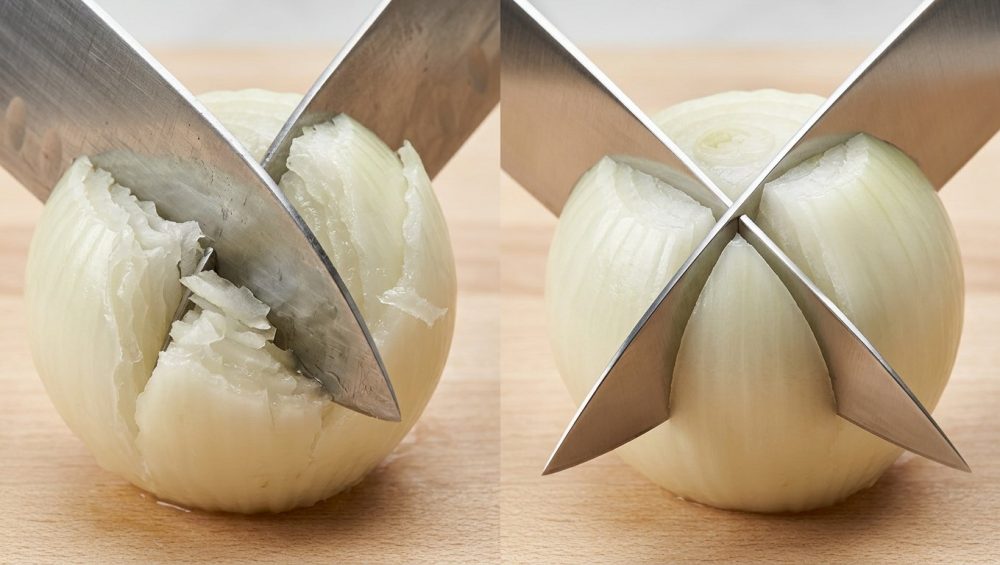
Picture this: You are standing at your kitchen counter on a Tuesday evening. You just wanted to throw together a quick mirepoix for a soup. Five minutes later, your mascara is running down your face, your eyes are burning like you just walked face-first into a chemical plant, and you are seriously questioning your life choices. You have tried all the ridiculous internet hacks. You chilled the onion. You left the root on. You even tried wearing your kid’s swimming goggles while prepping dinner.
But here is the brutally honest truth that no one wants to admit: the onion is not the problem. You are crying because your knife is an absolute joke.
If you want to finally stop weeping over onions, you need to understand that the hidden culprit behind your culinary misery is that dull, neglected, factory-stamped piece of metal you call a chef’s knife. You do not have “sensitive eyes,” and the allium family is not out to get you. You are simply using a blunt instrument to do a razor’s job. Today, we are diving deep into the microscopic physics of blade edges, the botanical warfare of the vegetable kingdom, and how basic knife maintenance will fundamentally change your prep game.
The Botanical Warfare of the Allium Family
To understand why a dull knife makes you cry, we first have to understand what an onion is actually doing when you cut into it. Onions (Allium cepa) are survivalists. They are stationary bulbs growing in the dirt, packed with energy and nutrients. Because they cannot physically run away from voles, insects, or hungry humans, they evolved a highly sophisticated, binary chemical weapon system to deter predators,.
As the onion grows, it pulls sulfur from the surrounding soil and converts it into amino acid sulfoxides, primarily one known as PRENSCO (1-propenyl-L-cysteine sulphoxide). These sulfoxides float peacefully in the cytoplasm of the onion’s cells,. However, safely sequestered nearby inside a microscopic cellular sac called a vacuole, is a reactive enzyme called alliinase,. As long as the cell remains intact, the PRENSCO and the alliinase never touch.
When you breach the cell wall—say, by biting into it or chopping it—you pop that vacuole. The alliinase floods out and mixes with the PRENSCO, instantly converting the amino acid sulfoxides into sulfenic acids,.
For decades, scientists believed this was the end of the chemical sequence. But in 2002, researchers discovered a second, highly specific enzyme at play: Lachrymatory Factor Synthase (LFS),. The LFS enzyme immediately snatches up those newly formed sulfenic acids and rapidly converts them into a highly volatile sulfur compound called syn-propanethial-S-oxide,.
This chemical is quite literally tear gas. Because it is a volatile compound, it vaporizes at room temperature, floats up from your cutting board, and makes contact with the moisture layer covering your cornea,. Your nervous system detects the irritant, registers it as a threat, and immediately triggers your lacrimal glands to flush it out with tears.
It is a brilliant, highly effective defense mechanism. But it only deploys when the onion’s cells are violently ruptured. When you are rushing through simple weeknight dinners, the last thing you need is a face full of botanical tear gas. The severity of this chemical reaction is entirely dependent on exactly how you break those cells. Which brings us to your kitchen drawer.
The Microscopic Physics of a Dull Knife
To understand why a dull knife is your worst enemy, we have to look at the physics of a blade edge. A knife is, at its core, a simple machine: a wedge.
When a knife is properly sharpened, the apex of the edge is microscopically thin. According to the basic physics principle of pressure—where Pressure equals Force divided by Area ($P = F/A$)—a smaller surface area at the apex means you need to apply very little downward force to penetrate the onion’s papery skin.
But when you use a dull knife, that microscopic apex is completely gone. It has been rolled, chipped, and flattened into a blunt, U-shaped microscopic club. Because the surface area of the edge is now much larger, you have to bear down with significantly more physical force to break the surface tension of the vegetable,.
Here is where the physics of the wedge violently turns against you. When you force a blunt wedge into a solid object, the excessive downward force is converted into intense lateral (sideways) force. Instead of cleanly severing the cell walls in a microscopic, surgical line, your dull knife acts like a snowplow. It violently crushes, tears, and mangles thousands of surrounding cells,.
You are essentially popping millions of those microscopic, alliinase-filled water balloons all at once.
The result is a massive, explosive chemical reaction. In fact, a January 2026 physics study utilizing high-speed cameras revealed that rapid chopping with a dull knife physically shoots droplets of onion juice into the air at speeds of nearly 40 meters per second. For those keeping track at home, that is roughly 90 miles per hour. Your dull knife is literally acting as a high-speed aerosolizer for syn-propanethial-S-oxide.
Using a blunt blade to prep your vegetables is one of the most common rookie kitchen mistakes, and it is entirely preventable. You are not cutting the onion; you are crushing it to death.
The Sharp Knife Advantage: Clean Severance
Contrast this high-speed demolition derby with the action of a truly sharp knife. A well-maintained blade with a refined edge geometry glides through the onion’s tissue with virtually zero resistance,.
Because the edge is so acute, the lateral force exerted on the food is drastically reduced. The blade cleanly severs only the specific cells directly in its microscopic path, leaving the adjacent cells completely intact and their vacuoles unruptured,.
Fewer broken cells mean less alliinase is released into the cytoplasm. Less alliinase means less sulfenic acid is produced. Less sulfenic acid means the Lachrymatory Factor Synthase has nothing to work with, drastically reducing the production of the volatile syn-propanethial-S-oxide,. The same 2026 high-speed camera study confirmed that slow, steady chopping with a highly sharpened blade kept the chemical droplets from even reaching eye level.
If you want to understand the ergonomics and blade geometry that make this possible, you have to look at the bevel. Western chef’s knives typically feature a 20-degree angle per side, which is durable but slightly wider. Japanese knives often feature a 15-degree angle (or even sharper), which provides an unbelievably clean cut through fibrous vegetables.
When you slice an onion with a razor-sharp, 15-degree edge, the cutting board remains completely dry. The onion pieces retain their structural integrity, they do not turn to mush when sautéed, and your eyes remain perfectly clear. You are bypassing the plant’s defense mechanism through sheer mechanical precision.
The “No-Go” Rule: Banishing Toxic, Cheap Kitchenware
As a home cook, your time is your most valuable asset. I have absolutely zero patience for cheap, gimmicky kitchenware that makes your life harder, your food worse, and your prep time longer.
If you bought a brightly colored, $15 knife from a supermarket endcap, or if you are still using a flimsy blade with a peeling, toxic non-stick coating that flakes mystery chemicals into your food, throw it in the trash immediately. I am completely serious. When it comes to banishing toxic kitchen gear, cheap knives are at the top of my hit list.
These bargain-bin knives are stamped from soft, low-grade stainless steel alloys with a Rockwell Hardness (HRC) of maybe 52. They physically cannot hold a sharp edge. The moment they make contact with a cutting board, the soft steel rolls over on itself. You can sharpen them on Monday, and by Wednesday, they are back to crushing your vegetables and making you cry.
Furthermore, a dull knife is infinitely more dangerous than a sharp one. Because of the immense downward force required to break the onion’s skin with a blunt edge, the blade is highly likely to slip sideways. When a dull knife slips under heavy pressure, it goes straight into your fingers.
You do not need a culinary degree to cook like a professional, but you absolutely must respect your tools. You need a knife forged from high-carbon stainless steel (like VG-10) or a traditional high-carbon steel. If you are willing to invest in aogami super steel, you will experience edge retention that borders on witchcraft. These harder steels (HRC 60+) can be sharpened to a terrifyingly acute angle and will actually hold that geometry through months of heavy vegetable prep.
The Science of Edge Retention
Recent metallurgical studies on dynamic cutting analysis have proven that Initial Cutting Performance (ICP) is dictated by the edge inclusive angle, while Total Card Cut (TCC)—the metric for edge retention—is governed by the synergistic interaction between the steel’s matrix hardness and its carbide characteristics.
In plain English? A sharp angle cuts beautifully, but if the steel is cheap and soft, the edge will instantly degrade. High-quality knives have microscopic, ultra-hard carbides distributed evenly throughout the steel matrix, allowing them to maintain that 15-degree geometry long after a cheap supermarket knife has surrendered. Stop buying garbage. Buy one good knife, and it will outlast you.
The Masterclass on Blade Maintenance
Owning a high-quality knife is only half the battle; the other half is maintenance. A $300 Japanese chef’s knife will still turn into a blunt, onion-crushing instrument if you treat it like a crowbar.
First, let’s clear up the biggest misconception in the culinary world: honing is not sharpening.
When you use your knife, the microscopic apex of the edge gets pushed out of alignment. It bends slightly to one side, creating what feels like a dull edge. A honing rod—that long steel or ceramic stick that came with your knife block—does not remove metal. It simply pushes those microscopic teeth back into a straight, aligned apex. You should be honing your knife every single time you cook. A few quick swipes before you start chopping will keep a good blade performing beautifully.
Sharpening, on the other hand, physically removes metal to grind a brand-new edge,. For this, you need a whetstone. Do not use those cheap, pull-through carbide sharpeners; they will aggressively chew up your blade, strip away too much metal, and completely ruin the geometry of the bevel. Learning to use a 1000/6000 grit water stone takes twenty minutes of practice, and it is one of the essential tools every beginner needs to master. You only need to use a whetstone every few months, depending on how often you cook.
The Cutting Board Factor
Your cutting surface matters just as much as your blade. If you are cutting on glass, marble, granite, or incredibly hard bamboo cutting boards, you are instantly destroying your knife’s edge.
Glass and stone are significantly harder than steel; they will flatten your microscopic apex on the very first slice. Bamboo, while marketed as an eco-friendly wood alternative, is actually a grass that is heavily loaded with natural silica. Cutting on silica is the microscopic equivalent of dragging your knife across sandpaper.
To protect that delicate 15-to-20-degree geometry, you must switch to a soft, end-grain wood board (like walnut, maple, or cherry) or a high-quality rubberized commercial board (like Hasegawa or Asahi). These materials are soft enough to allow the knife edge to bite into the surface without rolling or chipping the steel.
Debunking the Pretentious Onion Hacks
Because most people refuse to sharpen their knives, the internet is overflowing with ridiculous, pseudo-scientific “hacks” to stop onion tears. It is time to debunk them with actual science. If you want to cure cooking anxiety, stop relying on gimmicks and start fixing the root cause of the problem.
- Chewing gum or holding a piece of bread in your mouth: Utter nonsense. The syn-propanethial-S-oxide gas reacts with the moisture in your eyes, not your mouth,. Breathing through your mouth might slightly redirect the airflow around your face, but it will not stop a 90mph droplet spray generated by a blunt knife.
- Lighting a candle next to the cutting board: The working theory here is that the open flame burns off the volatile sulfur compounds before they reach your eyes. Unless you are chopping your onion inside a roaring bonfire, a tiny candle wick is not going to oxidize enough tear gas to save your cornea.
- Microwaving the onion before cutting: This technique actually denatures the alliinase enzyme, which technically stops the chemical reaction from happening. But it also cooks the onion, turning it into a rubbery, steaming, structurally compromised mess before you even start prepping.
- Running the onion under water while chopping: This is incredibly dangerous. A wet onion is a slippery onion, and a slippery onion combined with a dull knife is a one-way ticket to the emergency room. Furthermore, washing the onion washes away its natural flavor compounds.
- Chilling the onion in the fridge or freezer: Out of all the hacks, this is the only one with a grain of scientific truth. Thermodynamics dictates that colder temperatures slow down the volatility of gases. A cold onion will release less syn-propanethial-S-oxide into the air because the gas lacks the thermal energy to vaporize quickly. However, it is merely a band-aid for a bad knife. You are still crushing the cells; you are just delaying the inevitable.
The Step-by-Step Guide to Slicing Like a Pro
Now that you have banished your toxic gear, invested in a razor-sharp knife, and secured a proper wooden cutting board, let’s talk technique. The way you physically approach the onion dictates how much chemical warfare you trigger. Consider this your essential kitchen survival guide for allium prep.
1. Respect the Root
The highest concentration of amino acid sulfoxides and alliinase enzymes is located in the basal plate—the hairy root end of the onion. If you slice the root off first, you are immediately unleashing a massive, concentrated dose of lachrymatory factor into the air. Leave the root intact! It acts as a convenient, structural handle while you dice, and it keeps the most volatile chemicals safely contained.
2. The Halving
Slice off the stem end (the pointy top of the onion). Place the newly created flat side down on the board for stability. Now, slice straight down through the center of the hairy root, dividing the onion into two equal halves. Peel back the papery skin and discard it.
3. The Horizontal Cuts
Place one onion half flat against the board. Place your non-dominant hand flat on top of the onion to hold it steady. Make two or three horizontal cuts parallel to the cutting board, stopping just short of the root. Let the sharp blade do the work; do not force it. A sharp knife will glide through the flesh without requiring you to push hard.
4. The Vertical Cuts
Next, make a series of vertical cuts from the stem end toward the root, again leaving the root intact. Keep the tip of your knife on the board and use a smooth, rocking motion.
5. The Final Dice
Finally, cut across your vertical slices. Because your knife is sharp, it will effortlessly sever the grid of cells you just created, producing perfectly uniform, dry, beautifully diced onion pieces. Toss the intact root in the compost bin.
Because you used a sharp blade, the cutting board will be dry. The onion will not be bruised. And most importantly, your eyes will be completely fine.
The Final Slice
You do not need to attend a prestigious culinary institute in Paris to achieve professional-level results in your home kitchen. You just need to understand the basic mechanics of your ingredients and your tools. Cooking is not magic; it is applied physics and chemistry.
The next time you find yourself weeping uncontrollably over a cutting board, do not blame the onion. Do not reach for the swim goggles. Do not light a candle. Look at the piece of steel in your hand. A dull knife is a time-wasting, cell-crushing, tear-inducing liability that has no place in a modern kitchen.
Take the time to maintain your blade. Refine that edge geometry. Treat your kitchen tools with respect, and they will reward you with speed, precision, and perfectly dry eyes. Cooking should never be a painful struggle—it should be an absolute triumph. Now, go hone your knife and show that mirepoix who is boss.