Picture this: It is a beautiful Saturday evening. You have spent the last hour meticulously chopping vegetables, blooming aromatic spices in oil, and making your kitchen smell like a five-star Southeast Asian restaurant. Your friends are arriving in twenty minutes for a cozy, communal curry night. You pop open a can of coconut milk, pour it into the bubbling pot, and turn around for exactly thirty seconds to pour yourself a well-deserved glass of Pinot Grigio.
When you turn back to the stove, your masterpiece has transformed into a nightmare. Instead of a silky, luxurious, creamy broth, you are staring at a greasy oil slick floating on top of watery, translucent liquid, speckled with unappetizing, chalky white curds.
Take a deep breath. Pour the wine. It is not a failure of your culinary soul, and you do not need to throw the pot out the window. Boiling coconut milk into oblivion is one of those classic rookie kitchen mistakes that happens to the best of us. As a home cook who has set off the smoke detector more times than I care to admit, I can promise you that cooking is not magic—it is just food science. And once you understand the science of why coconut milk throws a tantrum, you will never serve a broken, greasy curry again.
The Anatomy of a Kitchen Disaster: What Does “Curdled” Actually Mean?
Before we can fix the problem, we need to understand what we are actually looking at when a curry “breaks.”
The Oil Slick Phenomenon
When coconut milk curdles, it undergoes a physical separation. You will notice a distinct layer of clear or yellowish oil pooling at the surface of your pot. Beneath that oil, the liquid looks thin and watery, and suspended throughout the mixture are tiny, grainy white lumps. This is what chefs refer to as a “split” or “broken” emulsion.
Why It Tastes Fine but Looks Like a Crime Scene
Here is the infuriating part: if you close your eyes and taste a spoonful of curdled curry, it probably tastes absolutely fine. The flavor profile of the ginger, garlic, lemongrass, and chili paste has not changed. But we eat with our eyes first. The texture of a broken curry is fundamentally unpleasant. Instead of coating your tongue in a velvety, rich blanket of flavor, the separated oil coats your mouth in a slick, greasy film, while the grainy protein curds feel gritty against your palate. You wanted a comforting, restaurant-quality bowl of warmth, and instead, you have a pot of oily dishwater.
The Food Science: Why Your Coconut Milk is Throwing a Tantrum
To conquer the kitchen, you have to think like a chemist. Do not worry, I have zero patience for pretentious chef-speak, so we are going to break this down into plain English.
Emulsions 101: Oil and Water Hate Each Other
Coconut milk is what scientists call an oil-in-water emulsion. It is primarily made up of two things: water and coconut fat. As we all know, oil and water despise each other. Left to their own devices, they will always separate.
So, how do they stay mixed in the can? The answer is protein. Coconut milk contains natural plant proteins that act as emulsifiers. Think of these proteins as microscopic peacemakers. One end of the protein molecule grabs onto a droplet of water, and the other end grabs onto a droplet of fat. By holding hands with both, the proteins keep the fat evenly suspended throughout the water, creating that opaque, milky white liquid we love.
The Boiling Point Betrayal (Temperature Dynamics)
Those protein peacemakers are highly sensitive to their environment, and their biggest enemy is heat. When you crank up the heat on your stove and bring your curry to a rolling boil (around 100°C or 212°F), you are introducing a massive amount of thermal energy into the pot.
As the temperature rises, the water in the coconut milk begins to evaporate. Simultaneously, the intense heat causes the coconut proteins to denature—meaning they physically unravel and lose their shape. Once the proteins denature, they drop the fat droplets they were holding onto. Without the proteins to keep the peace, the fat droplets immediately rush together, coalescing into large pools of oil. The unraveled proteins clump together into those chalky white curds. The emulsion is officially broken, and your curry is ruined.
The Acid Trap: Lime Juice and Tomatoes
Heat is not the only thing that causes coconut milk to split. Acid is the secondary culprit. I am usually the first person screaming from the rooftops that your dinner actually needs acid to taste balanced, but timing is everything.
Ingredients like fresh lime juice, tamarind paste, or tomatoes significantly lower the pH of your curry. Just like extreme heat, a highly acidic environment causes the proteins in the coconut milk to denature and curdle. If you squeeze a lime into a pot of rapidly boiling coconut milk, you are essentially hitting the self-destruct button on your emulsion.
The Great Coconut Milk Divide: To Crack or Not to Crack?
If you have ever tried to decode pretentious recipe jargon, you might have seen the phrase “cracking the coconut cream” and thought it involved a hammer. This is where things get slightly complicated, because in certain culinary traditions, curdling the coconut milk is actually the goal.
Traditional Thai Curries vs. Cozy Coconut Broths
There is a massive distinction between how coconut milk is treated in authentic, traditional Thai curry preparation versus how it is treated in Western-style coconut soups or casual weeknight curry broths.
If you are making a modern, cozy, soup-like curry where the goal is a homogenous, velvety broth, you want to avoid splitting the milk at all costs. But if you are making a traditional Thai Green Curry or Panang Curry, the process is entirely different.
The “Cracking the Cream” Technique Explained
In traditional Thai cooking, chefs intentionally “crack” or split the coconut cream. They scoop the thick, solid white cream from the top of the can and place it in a hot wok. They boil this cream vigorously until the water evaporates and the coconut proteins break down, leaving behind a pool of pure, separated coconut oil.
Why do they do this? Because they use that separated coconut oil to fry their homemade curry pastes. Frying the aromatics in pure coconut fat extracts the fat-soluble flavor compounds from the chilies, lemongrass, and galangal, resulting in an incredibly intense, complex flavor profile.
However—and this is the crucial step that home cooks miss—once the paste is fried in the cracked cream, the chef adds the rest of the thinner coconut milk to the wok, lowers the heat, and gently simmers the dish. They do not boil the final soup.
The Grocery Store Minefield: Choosing the Right Can
You can take all the time in the world to chop your produce perfectly or figure out how to bring them back to life with an ice bath, but if you buy the wrong can of milk, your curry is doomed from the start. The grocery store aisle is a minefield of misleading labels.
Full-Fat vs. “Lite” (And Why “Lite” is a Scam)
Let me be brutally honest: never, ever buy “lite” or “light” coconut milk for a curry. “Lite” coconut milk is not a magical, diet-friendly invention. It is literally just regular coconut milk that has been heavily diluted with water.
Because it has a drastically lower fat content (often under 10%, compared to the 17-25% found in full-fat cans), it lacks the necessary fat-to-water ratio to maintain a stable emulsion when heated. It will almost always split into a thin, watery, flavorless mess. If you want a rich, creamy curry, you must buy full-fat coconut milk.
The Stabilizer Situation: Guar Gum and Friends
Turn around your can of coconut milk and read the ingredient list. Ideally, it should say two things: Coconut extract and water. However, many commercial brands add stabilizers and thickeners like guar gum, xanthan gum, or polysorbate 60.
These additives are not necessarily evil. Guar gum, derived from guar beans, is a natural polysaccharide that dramatically increases the viscosity of the liquid, physically preventing the oil and water from separating on the shelf.
Here is how this affects your cooking: If you are trying to make a traditional Thai curry and want to crack the cream to fry your paste, you must buy a brand without stabilizers (like Aroy-D or Chaokoh), because guar gum makes it nearly impossible to split the cream. But, if you are a beginner just looking to make a foolproof, creamy weeknight soup that will not curdle under pressure, a can with a little guar gum is actually your best friend, as it acts as an insurance policy against emulsion breakage.
Coconut Cream vs. Coconut Milk vs. Cream of Coconut
Do not mix these up.
- Coconut Milk: The standard liquid extracted from simmering one part shredded coconut in one part water. Perfect for curry broths.
- Coconut Cream: A much thicker, richer product made with a higher ratio of coconut to water (often around 4:1). It is excellent for incredibly rich dishes, but can be overwhelmingly heavy if used alone in a soup.
- Cream of Coconut: A heavily sweetened, syrupy product used for making Piña Coladas and desserts. If you put this in your savory chicken curry, you will ruin dinner.
Foolproof Techniques to Prevent Curdling in Your Curry
These techniques are so incredibly foolproof that you can pull off a spectacular meal even if you barely know how to cook. By controlling how and when the coconut milk meets the heat, you can guarantee a silky texture every single time.
Technique 1: The Late Addition Strategy
This is my absolute favorite time-saving hack for weeknight meals. Do not cook your vegetables and proteins in the coconut milk. Instead, sauté your curry paste, add your chicken and veggies, and simmer them in a cup of high-quality chicken or vegetable broth.
Once the meat is cooked through and the vegetables are perfectly tender, turn the stove burner completely off. Wait one minute for the bubbling to stop, and then stir in your room-temperature coconut milk. The residual heat of the broth will warm the milk through beautifully without ever bringing it to a boil, ensuring the emulsion stays perfectly intact.
Technique 2: Tempering Like a Pastry Chef
If you are making a recipe that absolutely requires the coconut milk to be heated, you need to temper it. Tempering is a classic culinary technique used to gently raise the temperature of a delicate ingredient so it does not suffer thermal shock.
Pour your canned coconut milk into a large mixing bowl. Take a ladle of the hot, simmering liquid from your curry pot and slowly drizzle it into the bowl of coconut milk while whisking constantly. Add one more ladle and whisk again. You have now gently raised the temperature of the coconut milk. You can now pour this warmed mixture back into the main pot with a much lower risk of it splitting.
Technique 3: The Cornstarch Safety Net
If you are cooking for a crowd and cannot afford to micromanage the stove, use a starch stabilizer. Before adding the coconut milk to the pot, whisk one tablespoon of cornstarch (or tapioca starch) into the cold milk until completely dissolved.
When you add this slurry to the hot pot, the starches swell and gelatinize. These swollen starch molecules physically get in the way of the coconut proteins, preventing them from clumping together, and keeping the fat droplets suspended. It gives the broth a slightly thicker, more luxurious mouthfeel while making the emulsion practically bulletproof.
Technique 4: Heat Control and the Gentle Simmer
If you must simmer your coconut milk, respect the heat. Once the milk is in the pot, the liquid should never exceed a gentle, lazy simmer. You are looking for a few tiny bubbles breaking the surface every couple of seconds. If you see a rolling, aggressive boil, you have gone too far. Turn the heat down to medium-low, and stir frequently.
Fixing a Broken Curry: Damage Control for the Desperate
Okay, so you got distracted, the pot boiled over, and the curry split. The oil is pooling. Is dinner ruined? Absolutely not. Grab a clean whisk—and please make sure you aren’t using cheap gear, because wondering why your silicone spatulas taste like soap while you’re trying to save a curry is a special kind of hell. Let’s fix this.
The Immersion Blender Rescue
Take the pot completely off the heat. Grab your immersion blender (stick blender). Submerge the blade fully into the liquid and blend on high for about 30 to 60 seconds. The sheer mechanical force of the rapidly spinning blades will physically smash the separated oil droplets back into microscopic pieces and force them back into the water phase, temporarily restoring the emulsion. Serve it immediately before it has a chance to separate again.
The Slurry Fix
If you do not have an immersion blender, you can force the emulsion back together using starch. In a small bowl, aggressively whisk one tablespoon of cornstarch with two tablespoons of cold water until smooth. Take your broken curry off the heat. Slowly pour the slurry into the pot while whisking the curry as fast and hard as you humanly can. Return the pot to a very low heat just until the broth thickens slightly. The starch will bind the stray oil and water together, masking the curds and rescuing the texture.
Essential Gear for the Perfect Curry Night
I am absolutely relentless when it comes to banishing toxic kitchen gear from your house. You cannot expect professional-level results if you are using equipment that actively fights against you.
Ditching Toxic Pots for Good
Do not cook your beautiful, aromatic curries in cheap, scratched, non-stick aluminum pots. Not only are you risking toxic Teflon flakes peeling off into your food, but cheap, thin metal pots have terrible thermal conductivity. They create massive “hot spots” right above the burner flame. Even if you have the stove set to low, the liquid directly over that hot spot might be boiling aggressively, causing your coconut milk to curdle locally before you even realize what is happening. Just like using the wrong cutting surface is secretly ruining your knives over time, using paper-thin pots will ruin your temperature control.
The Magic of Enameled Cast Iron
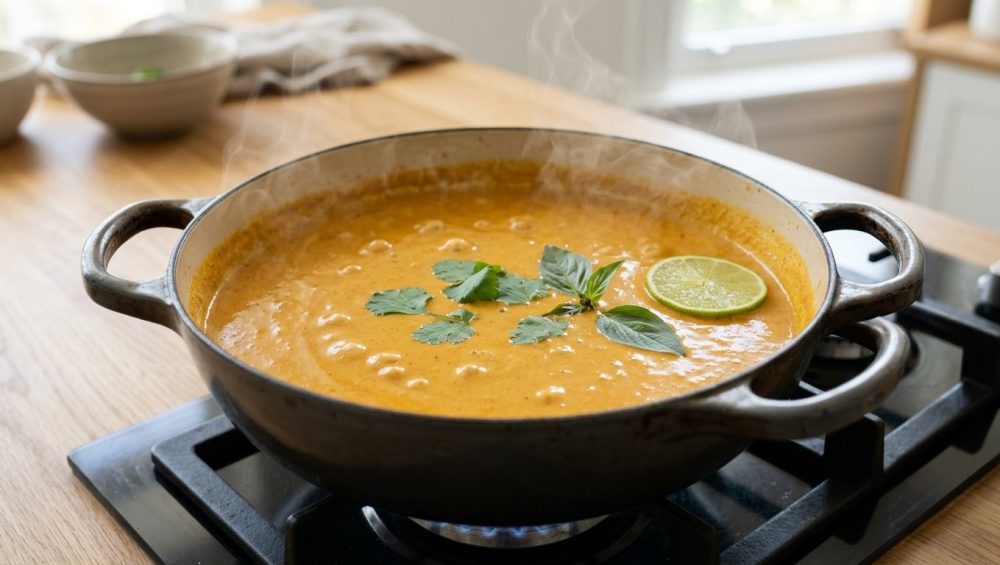
For dishes that require gentle, even simmering like curries and stews, you need heavy-bottomed cookware. An enameled cast-iron Dutch oven is the ultimate tool for this job. Cast iron takes a while to heat up, but once it does, it retains that heat and distributes it perfectly evenly across the entire base of the pot. This eliminates hot spots and allows you to maintain a perfectly controlled, lazy simmer without accidentally scorching or splitting your coconut milk. Plus, the enamel coating is non-reactive, meaning you can safely add acidic ingredients like lime juice without worrying about metallic off-flavors.
Organizing the Ultimate Stress-Free Curry Gathering
Hosting a dinner party should not induce a panic attack. If you are sweating over a boiling pot while your guests are sitting in the living room, you are doing it wrong.
Prep Ahead, Party Later
Curry is the ultimate make-ahead meal because the flavors actually improve as they sit and meld. Having your ingredients prepped and laid out in a permanently organized kitchen makes the actual cooking phase take ten minutes.
Make your curry base hours before anyone arrives. Sauté your aromatics, cook your proteins and vegetables in the broth, and season it perfectly. Then, turn the stove off and go take a shower. When your friends arrive, you simply turn the stove back on to gently reheat the base, stir in your room-temperature coconut milk at the very end using the Late Addition Strategy, and carry the pot to the table. That is the true art of effortless hosting: doing the stressful part while wearing sweatpants, and doing the easy part with a glass of wine in hand.
Plating and Presentation Hacks
To make your home-cooked curry look like it came from a high-end restaurant, serve it family-style in a large, pre-warmed ceramic bowl. Garnish the top with freshly torn cilantro leaves, a handful of Thai basil, and a very deliberate drizzle of chili oil for a pop of vibrant red color against the creamy white broth.
Crucially, serve your fresh lime wedges on a small plate on the side. Do not squeeze the lime juice into the main pot of hot curry, or the acid will curdle the milk right there on the dining table! Let your guests squeeze their own lime juice into their individual bowls just before eating.
Conclusion: Embrace the Science, Enjoy the Curry
Cooking with coconut milk does not have to be a game of culinary roulette. By understanding the simple food science behind emulsions, controlling your temperatures, and utilizing smart, time-saving techniques, you can completely eliminate the anxiety of a broken, greasy broth.
Remember, you do not need a culinary degree to make mind-blowing food. You just need a little bit of patience, a decent heavy-bottomed pot, and the confidence to know that you are the boss of your kitchen. So grab a high-quality can of full-fat coconut milk, invite your friends over, and get ready to serve the silkiest, coziest curry of your life. Cheers!