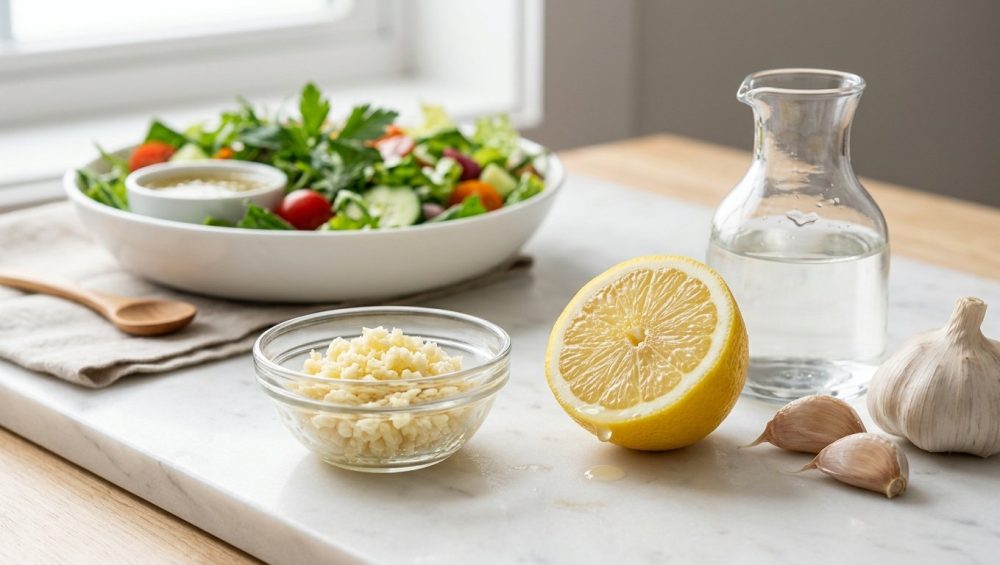
Listen up, my weekend culinary warriors. We need to have a serious talk about the elephant in the salad bowl. You have meticulously sourced the most beautiful, vibrant organic greens. You have whisked together a gorgeously expensive extra virgin olive oil with a perfectly balanced Dijon mustard. You followed the recipe, minced a clove of raw garlic, tossed it into the vinaigrette, and proudly served it to your dinner guests. And then it hits. That aggressive, fiery, eye-watering burn that totally obliterates the delicate flavors of your meal and leaves you with dragon breath until next Tuesday.
If you want to truly master the art of the kitchen, you have to stop fighting your ingredients and start understanding them. You do not need a culinary degree to make restaurant-quality food, but you do need to know a little bit of food science. Today, I am going to teach you a brilliantly simple, science-backed, heat-free trick to completely tame raw garlic. We are going to dive deep into the magical world of the acid soak.
The Raw Garlic Conundrum: Why Your Vinaigrette Tastes Like Fire
Let me be brutally honest with you: raw garlic is a bully. I have zero patience for pretentious chef-speak that pretends a giant mouthful of raw, unmitigated garlic is somehow a “rustic” delight. It is not. It is painful.
When you are cooking a weeknight dinner, time is money. You do not always have forty-five minutes to slowly roast a head of garlic in the oven to sweeten it up, nor do you have the patience to gently confit cloves in oil on the stovetop when you are just trying to throw together a quick Greek salad or a batch of weeknight guacamole. You need the sharp, bright, savory punch that raw garlic provides, but you need it to behave.
The problem is that garlic becomes exponentially more pungent the longer it sits after being cut. If you mince a clove of garlic and let it sit on your cutting board while you prep the rest of your ingredients, you are unknowingly allowing a violent chemical reaction to take place. By the time that garlic makes it into your dressing, it has transformed from a sweet, aromatic bulb into a biological weapon. To stop this from happening, we have to look at what is actually going on inside the cells of that innocent-looking clove. Understanding this simple biochemical reaction is the ultimate way to eliminate kitchen chaos when you are rushing to throw together a weeknight dinner.
Botany 101: The Chemical Warfare Inside a Garlic Clove
Garlic (Allium sativum) is a botanical marvel, but it is also highly defensive. In the wild, the garlic plant does not want to be dug up and eaten by soil-dwelling nematodes, insects, or foraging herbivores. To protect itself, the plant evolved an ingenious, binary chemical weapon system.
The Enzyme and the Amino Acid: A Destructive Romance
Inside the intact cells of a garlic clove, there is an odorless, non-protein amino acid called alliin (S-allyl-L-cysteine sulfoxide). Safely locked away in a completely separate cellular compartment—specifically the bundle sheath cells—is an enzyme called alliinase. As long as the clove remains whole and undamaged, these two compounds never meet. The garlic remains peaceful, sweet, and practically odorless.
But the moment you crush, slice, mince, or bite into that clove, you violently rupture those microscopic cellular walls. The alliin and the alliinase flood into the intercellular space and mix together. The alliinase enzyme acts as a biological catalyst, rapidly cleaving the alliin molecules to produce a highly volatile, sulfur-rich compound called allicin (diallyl thiosulfinate).
Allicin is the chemical entirely responsible for that aggressive, burning, pungent garlic flavor and aroma. It is a literal defense toxin designed to repel attackers. When your mouth is burning from a bite of raw garlic, you are experiencing the exact chemical warfare that was meant to deter a hungry gopher.
The Time Factor: Why It Gets Worse Before It Gets Better
This enzymatic reaction is not instantaneous. It takes time for the alliinase to process the available alliin. The production of allicin generally peaks about 10 to 15 minutes after the garlic has been crushed or minced. This is the exact reason why a tzatziki sauce or a vinaigrette that tasted perfectly fine when you first mixed it suddenly tastes like pure fire an hour later. The enzymes were continuously working in the background, pumping out more and more allicin.
Denaturing the Beast: The Science of the Acid Soak
So, how do we stop this botanical warfare without turning on the stove? We manipulate the pH. Enzymes are incredibly fussy biological machines. They are proteins folded into highly specific, complex three-dimensional structures. This shape is maintained by delicate hydrogen bonds and ionic interactions. For an enzyme to work, its “active site” must perfectly match the shape of its target molecule—much like a key fitting into a lock.
How pH Levels Hijack the Enzymatic Reaction
According to biochemical research, the alliinase enzyme operates at peak efficiency in a strictly neutral environment, specifically at a pH of around 6.5 to 7.0, and at an optimal temperature of about 35°C (95°F).
When you introduce a strong culinary acid—like lemon juice, which has a pH of around 2.0 to 2.5, or white wine vinegar, which sits around 2.5 to 3.0—you flood the environment with positively charged hydrogen ions. These ions aggressively interfere with the delicate bonds holding the alliinase enzyme together. The sudden, drastic drop in pH forces the enzyme’s protein structure to unfold and collapse. In scientific terms, the enzyme is denatured.
Once the alliinase is denatured, its active site is permanently deformed. The key no longer fits the lock. The conversion of alliin into allicin instantly halts. By doing this immediately after mincing, you stop the chemical reaction in its tracks before the garlic reaches its peak pungency. You are left with the sweet, savory, foundational garlic flavor, completely stripped of its aggressive, burning bite.
The Sassy Sous-Chef’s Masterclass: How to Tame Raw Garlic Without Cooking It
Now that we know the science, let’s talk about execution. This is a technique you will use for the rest of your life. It takes exactly zero extra effort, but the timing and the tools matter immensely.
Step 1: The Mincing (And a Warning About Toxic Garlic Presses)
First, we need to break down the garlic. Before we go any further, let’s talk about your equipment. You know I am on a lifelong crusade when it comes to banishing toxic kitchen gear from our homes, and the cheap metal garlic press is public enemy number one.
Recent independent consumer testing has revealed a horrifying truth about bargain-bin metal garlic presses. Many of them are cast from low-grade zinc alloys or sintered metal powders that contain terrifying levels of heavy metals. In fact, some unbranded, bare-metal garlic presses have tested positive for over 2,600 parts per million of lead, alongside trace amounts of cadmium. Furthermore, that shiny chrome coating on cheap presses inevitably flakes off into your food after a few trips through the dishwasher. We are absolutely not adding toxic heavy metals and mystery paint chips to our weeknight meals. Throw it in the trash.
Instead, use a high-quality ceramic grater to create a fine paste safely and efficiently. Alternatively, use proper knife skills to finely mince the clove. A sharp chef’s knife and a solid cutting board are the absolute essential kitchen tools for beginners that will prevent these prep disasters. Whatever you do, do not hack at it with a dull knife, which will brutally tear the cell walls and release an uncontrollable flood of enzymes before you can get the acid involved.
Step 2: The Acid Bath (Choosing Your Weapon)
The moment your garlic is minced or grated, you are on the clock. You have seconds before the allicin production ramps up. Elegantly scoop up your perfectly minced garlic with a stainless steel bench scraper and transfer it directly into a small bowl.
Immediately submerge the garlic in your chosen acid. The acid you choose should be whatever acid is already called for in your recipe. If you are making a vinaigrette, use your white wine vinegar, apple cider vinegar, or sherry vinegar. If you are making guacamole or a salsa, use freshly squeezed lime juice. If you are making hummus, use fresh lemon juice. You need just enough acid to fully submerge and coat the minced garlic—usually about one to two tablespoons per clove is more than sufficient.
Step 3: The 10-Minute Waiting Game
Give the garlic and acid a quick stir to ensure every single piece is coated. Now, walk away.
You must let the garlic steep in the acid for a minimum of 10 minutes. It takes a little bit of time for the acidic liquid to fully penetrate the microscopic plant tissues and denature the localized alliinase enzymes. This is the perfect time-saving hack for a busy weeknight. While the garlic is taking its little spa bath, you can grab your carbon steel y-peeler to prep your carrots or shallots for the rest of the meal. By the time you have finished chopping your salad greens or mashing your avocados, the garlic will be perfectly mellowed and ready to use.
Rookie Mistakes: Why Your Acid Soak Failed
I have seen countless home cooks try this trick and still end up with a spicy, burning dressing. If your acid soak failed, you likely committed one of these three cardinal kitchen sins.
Mincing Too Far in Advance
If you mince your garlic, leave it sitting on the cutting board for ten minutes while you chat on the phone, and then add it to the lemon juice, you have already lost the war. The alliinase has already had plenty of time to convert the alliin into allicin. The acid will denature the enzyme and stop future production, but it cannot undo the allicin that has already been created. You must submerge the garlic in the acid immediately after cutting it.
The Hydrophobic Oil Barrier Problem
This is the most common mistake I see, especially when people are making salad dressings. Oil and water do not mix. If you whisk your olive oil and your vinegar together in a bowl, and then drop your minced garlic into the emulsion, the trick will not work.
Because olive oil is a lipid (fat) and the acid is water-based, the oil will coat the pieces of garlic, creating a hydrophobic barrier. The water-based acid cannot penetrate the lipid layer of the oil to reach the garlic cells. Meanwhile, underneath that microscopic oil slick, the alliinase is happily surviving in its neutral, water-based cytoplasm, continuously pumping out harsh allicin. You must always soak the garlic in pure, unadulterated acid first. Only after the 10-minute steeping process is complete should you whisk in your olive oil.
Using a Weak Acid
Not all liquids are acidic enough to denature proteins. Water will do nothing. Broth will do nothing. You need a liquid with a pH well below 4.0. Stick to pure citrus juices (lemon, lime) or standard culinary vinegars (white wine, red wine, apple cider, champagne). Do not try to use a highly diluted, sweet balsamic glaze and expect the same chemical reaction.
Where to Deploy Your Newly Tamed Garlic
Once you master this heat-free technique, a whole new world of raw culinary applications opens up to you. Here is exactly where you should be using the acid soak in your everyday cooking.
Vinaigrettes and Salad Dressings
This is the holy grail application. A classic French vinaigrette relies on the holy trinity of acid, oil, and aromatics. Mince a clove of garlic, let it sit in two tablespoons of white wine vinegar and a teaspoon of Dijon mustard for 10 minutes. Then, slowly whisk in six tablespoons of extra virgin olive oil. You will have a dressing with a profound, savory depth of flavor, completely devoid of the sharp bite that usually ruins a delicate butter lettuce salad.
Guacamole, Salsas, and Pico de Gallo
Raw onions and raw garlic are notorious for overpowering a batch of fresh guacamole or pico de gallo. The acid soak works on onions, too (they contain a similar enzyme-driven defense mechanism). Mince your garlic and finely dice your red onions, and submerge them in the juice of two limes while you prep your tomatoes, cilantro, and jalapeños. By the time you fold everything into your mashed avocados, the aromatics will be perfectly balanced, sweet, and tangy.
Tzatziki, Hummus, and Creamy Dips
Middle Eastern and Mediterranean dips rely heavily on raw garlic. But if you have ever made hummus that tasted like battery acid the next day, you know the dangers of unchecked allicin. Submerge your minced garlic in fresh lemon juice before blending it into your chickpeas and tahini. Just as I always aggressively remind you to ditch the hand mixer when making mashed potatoes to avoid a gluey nightmare, you must avoid the blender when mixing acid into your garlic if you want a clean flavor. Simply let the garlic steep in a small bowl of lemon juice first, then pour that infused, enzyme-denatured liquid into your food processor with the rest of your ingredients.
Pesto and Raw Herb Sauces
Pesto is a brilliant, vibrant sauce that is often ruined by raw garlic that continues to steep in the oil as the pesto sits in the fridge. While pesto does not traditionally contain a heavy acid like vinegar, adding just a tiny squeeze of lemon juice to the garlic before blending it with the basil and pine nuts will stabilize the flavor profile. Your pesto will taste just as sweet and herbaceous on day three as it did on day one.
The Alternatives: How the Acid Soak Stacks Up Against Other Garlic Hacks
For the sake of being incredibly thorough, we must address the other methods people use to tame raw garlic. While the acid soak is my absolute favorite for raw applications, heat is the other primary way to denature enzymes. Let’s look at how the alternatives compare.
The Microwave Method
You can denature alliinase by applying rapid heat. If you place whole, unpeeled cloves of garlic in the microwave for 15 to 20 seconds, the radiation rapidly heats the water inside the cells, denaturing the enzymes before they have a chance to mix with the alliin. It works perfectly. However, the microwave method slightly cooks the garlic. It alters the texture, making it slightly softer, and changes the flavor profile from “bright and fresh” to “mildly steamed.” It is a great trick if you are in a pinch, but it lacks the vibrant, zesty punch that the acid soak provides for raw dressings.
The Blanching Method
Some chefs swear by blanching whole garlic cloves in boiling water for two to three minutes, then plunging them into an ice bath. Yes, the extreme heat denatures the alliinase. Yes, it mellows the garlic. But let’s be realistic: on a Tuesday night, I am not boiling a dedicated pot of water and preparing an ice bath just to make a side salad. It is a massive waste of time and creates unnecessary dishes. The acid soak requires zero heat, zero extra pots, and utilizes the acid you were already going to use in the recipe anyway.
If you ever decide to skip the raw application and cook the garlic instead, make sure your skillet is properly heated—always rely on the water drop test to ensure a perfectly non-stick surface before adding your oil and aromatics. But for anything raw, stick to the citrus.
Reclaiming Your Breath and Your Culinary Pride
Cooking should not be an exercise in enduring pain, nor should it require a chemistry degree to get dinner on the table. However, understanding the basic, fundamental science behind why our ingredients behave the way they do is the secret to unlocking true freedom in the kitchen.
The defense mechanisms of the garlic plant are no match for a little bit of lemon juice and ten minutes of patience. By simply manipulating the pH of your prep bowl, you can completely disarm the alliinase enzyme, prevent the formation of harsh allicin, and extract only the sweet, savory, aromatic brilliance that garlic has to offer.
So throw away that toxic, peeling metal garlic press. Sharpen your chef’s knife. And the next time you are whisking up a vinaigrette or mashing a bowl of guacamole, remember the magic of the acid soak. Your palate, your dinner guests, and your breath will thank you. Now pour yourself a glass of wine, get back in the kitchen, and show that garlic who is actually in charge.