Look at your cutting board. If you are currently staring at a puddle of red, watery seed-guts and a mangled, bruised pile of what used to be a beautiful, ripe tomato, put down the chef’s knife and step away from the counter.
We have all been there. You have a vision of a flawless Caprese salad, or perhaps a towering, diner-style BLT. You bought the gorgeous, expensive heirloom tomatoes from the farmers market. You bring them home, wash them lovingly, and then proceed to absolutely butcher them into a sad, squishy pulp. You are left wondering why your kitchen looks like a crime scene and why your sandwich is now a soggy, structural disaster.
Let me let you in on a little secret: It is not your fault. You do not lack some mystical culinary talent, and you certainly do not need a degree from Le Cordon Bleu to slice a vegetable (yes, botanically a fruit, but we are cooking, not writing a biology thesis). The problem is entirely rooted in physics, cellular biology, and the fact that you are using the wrong tool for the job.
When your standard straight-edge blades inevitably lose their sharp edge over time, they transform from precision instruments into blunt-force weapons. You end up pressing down on the tomato instead of slicing it, and the tomato loses that battle every single time.
It is time to stop the massacre. We are going to dive deep into the science of why tomatoes are so notoriously difficult to process, why your standard chef’s knife is failing you, and why a simple, inexpensive serrated utility knife is the ultimate kitchen upgrade that will instantly stop ingredient bruising. No fluff, no pretentious chef-speak—just the brutal, scientific truth about how to conquer your kitchen.
The Anatomy of a Kitchen Disaster: Why Your Tomatoes Are Bleeding Out
To understand why your tomatoes are turning into mush, we first have to understand what a tomato actually is from a structural standpoint. A tomato is a masterpiece of natural engineering, but it is also a walking contradiction. It is essentially a delicate water balloon wrapped in a microscopic suit of armor.
The Fortress Wall: The Exocarp
The outermost layer of the tomato is called the exocarp, or the skin. If you were to look at this skin under a microscope, you would see that the cells are incredibly tightly packed together. Nature designed this skin to be an impenetrable barrier to prevent disease, ward off pests, and stop the fruit from dehydrating in the hot summer sun.
Furthermore, this skin is coated in a natural hydrophobic cuticle. It is slick, glossy, and highly resistant to friction. When you drag a dull blade across it, the blade does not catch; it slips. This is why one of the most common beginner cooking mistakes is trying to saw at a tomato with a dull chef’s knife, only to have the blade slide off the side and nearly take off a finger. The exocarp is tough, fibrous, and surprisingly resilient to blunt pressure.
The Fragile Interior: The Mesocarp and Locular Gel
Now, let’s look at what lies beneath that tough exterior. The flesh of the tomato (the mesocarp) and the jelly-like substance surrounding the seeds (the locular gel) are incredibly soft. A tomato is composed of roughly 94 to 95 percent water. This water is not just floating around; it is held within a highly organized, fragile cellular matrix of pectin and delicate cell walls.
When you apply downward pressure to a tomato, you are effectively squeezing a gel-filled sac. If the skin does not immediately yield to the blade, the force of your hand is transferred directly into that delicate interior matrix. The internal pressure builds until the weak cell walls absolutely shatter. The result? The cellular structure collapses, the locular gel bursts out, and the mesocarp bruises and turns mealy. You have successfully ruined the texture and drained the flavor-packed juices directly onto your cutting board.
The Flawed Physics of the Straight-Edge Blade
Let’s talk about the mechanics of cutting. A standard chef’s knife or paring knife features a straight-edge blade. When properly honed and razor-sharp, a straight edge cuts by applying a continuous, microscopic wedge into the material.
The Problem with “Soft Solids”
In the realm of food physics, a tomato is classified as a “soft solid” or a gel encased in a membrane. Soft solids do not react well to downward pressure; they require a lateral slicing motion to separate their molecular bonds without crushing them.
If your straight-edge knife is even slightly dull—and let’s be brutally honest, if you are a weekend home cook, your chef’s knife is probably duller than a butter knife—it will fail to bite into the tomato’s glossy exocarp. Because the blade cannot pierce the skin, your natural instinct is to push down harder.
The Crush Zone
This is where the physics turn against you. By pushing down, you are increasing the blunt force on the top of the tomato. But because the skin is strong and the inside is soft, the tomato deforms. It flattens out. The blade finally breaks through the skin not by slicing it, but by rupturing it through sheer, brute-force tension. By the time the blade hits the cutting board, the damage is done. The internal cells have been crushed.
Just like tearing up over onions because a dull blade crushes the onion’s cell walls and releases volatile irritants, a squished tomato is a direct symptom of using the wrong tool. You are fighting the biological structure of the food, and the food is fighting back.
Enter the Unsung Hero: The Serrated Utility Knife
If a straight-edge knife is the wrong tool, what is the right one? Enter the serrated utility knife. This is not a bread knife, and it is not a paring knife. It is the Goldilocks of the kitchen block, and it is about to become your absolute best friend.
What Exactly Is a Serrated Utility Knife?
A serrated utility knife typically features a blade that is between 5 and 6 inches long. It is longer than a standard 3-inch paring knife, giving you enough runway to utilize a proper sawing motion, but it is significantly shorter and more nimble than a massive 10-inch bread knife.
The defining feature, of course, is the serrated edge. Instead of a smooth, continuous line, the edge is composed of a series of teeth or notches. These teeth can be pointed (like a traditional saw) or scalloped (featuring gentle, inverted curves).
The Perfect Middle Ground
A serrated utility knife is a piece of basic culinary equipment that punches far above its weight class. I constantly preach that professional-level results are achievable in a standard home kitchen, but only if you stop making things harder on yourself. You do not need to spend twenty minutes meticulously honing your 8-inch chef’s knife on a Japanese whetstone just to make a Tuesday night salad. You just need a blade whose geometry is specifically engineered to defeat the tomato’s armor.
The Science of the Slice: Friction, Pressure, and Surface Tension
Why does a serrated edge glide through a tomato like butter, even when the knife itself isn’t technically “razor sharp” in the traditional sense? It all comes down to the physics of pressure and surface area.
The Equation of Slicing
In physics, Pressure equals Force divided by Area (P = F/A). When you use a straight-edge knife, the entire length of the blade rests against the skin of the tomato. That is a relatively large surface area. To create enough pressure to break the skin, you have to apply a massive amount of downward force.
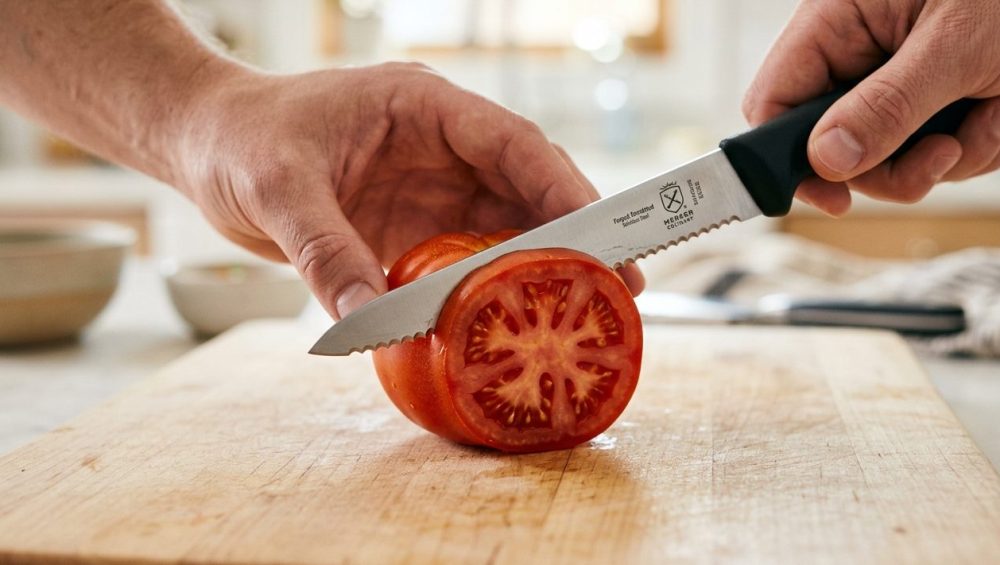
Now, look at a serrated knife. When the blade touches the tomato, only the very tips of the teeth make contact with the skin. The surface area is reduced to a fraction of a millimeter. Because the Area is so incredibly small, the Pressure at those specific contact points becomes astronomically high, even if you are applying almost zero downward Force.
Grip, Puncture, and Glide
The mechanics work in three distinct phases:
- The Grip: The microscopic points of the serrations catch onto the glossy, hydrophobic cuticle of the tomato. Unlike a straight blade, the teeth refuse to slip.
- The Puncture: Because the pressure is concentrated entirely on those tiny points, they instantly pierce the tough exocarp with zero downward crushing force.
- The Glide: Once the skin is breached, you utilize a gentle back-and-forth sawing motion. The curved scallops between the teeth smoothly slice through the soft, watery mesocarp without snagging or tearing the delicate gel matrix inside.
The result is a surgically precise slice. The cellular structure remains completely intact. The juices stay inside the slice where they belong, rather than bleeding out all over your counter. When you are in the middle of stressful weekday meal prep, this kind of instant, foolproof efficiency is exactly what you need.
Beyond the Tomato: The Hidden Versatility of the Serrated Utility Blade
I am a firm believer that time is money. I survive weekdays using clever shortcuts so I can be a perfectionist on the weekends. I despise unitaskers. If a tool only does one thing, it does not belong in my kitchen. Fortunately, the serrated utility knife is a multitasking powerhouse.
Once you understand the physics of why it works on tomatoes—defeating a tough exterior to protect a soft interior—you will start realizing how many other foods fit this exact structural profile.
Conquering the Crust: Citrus, Peaches, and Plums
Have you ever tried to slice a lemon or a lime with a dull knife, only to have it slip and squirt acidic juice directly into your eye? Citrus fruits have a tough, leathery rind protecting a soft, segmented interior. A serrated utility knife grips the rind and saws through it effortlessly.
The same applies to stone fruits. Peaches, plums, and nectarines have incredibly thin, tight skins that are highly prone to bruising. A straight blade will often crush the flesh before it breaks the skin. The micro-teeth of a serrated blade will pierce the peach skin instantly, allowing you to create beautiful, uniform wedges for a summer tart without turning the fruit into baby food.
The Ultimate Sandwich Knife
If you are making a BLT, a club sandwich, or a grilled cheese on thick artisan sourdough, the serrated utility knife is your weapon of choice. A standard chef’s knife will compress the bread, squish the tomatoes inside, and push all the mayonnaise and fillings out the back of the sandwich. The serrated utility knife easily saws through the crusty exterior of the bread and glides through the soft interior layers without applying any compressive weight.
Weekday Hacks for the Home Cook
Need to slice a block of hard salami or a tough, cured sausage? Serrated utility knife. Need to quickly halve a pint of cherry tomatoes without chasing them around the cutting board? Serrated utility knife. Just remember to scoop up your perfect slices with a handy metal bench scraper rather than dragging your knife edge across the board.
Nobody wants to eat a salad that looks like soggy roasted vegetables because the tomatoes bled out and watered down the vinaigrette. The serrated blade ensures your ingredients stay structurally sound, keeping your salads crisp and your sandwiches intact.
How to Choose the Right Serrated Utility Knife (And Avoid the Junk)
Now that I have convinced you that you desperately need this tool, we need to have a very serious conversation about quality. I have a strict “No-Go” rule in my kitchen. I have absolutely zero patience for toxic kitchen equipment that flakes mystery coatings into my food, bends under pressure, or rusts after three washes.
You do not need to spend two hundred dollars on a utility knife, but you absolutely must avoid the cheap, brightly colored, plastic-handled garbage sold in the bargain bins of big-box stores.
The “No-Go” Rule: Spotting Toxic and Flimsy Blades
Do not buy knives with painted blades. Those pastel-colored non-stick coatings will inevitably peel, chip, and end up in your dinner. You are cooking for your family, not running a chemical experiment.
Do not buy knives with flimsy, hollow plastic handles that feel weightless in your hand. A knife needs balance. If the blade is significantly heavier than the handle, or vice versa, you will lack control, which is incredibly dangerous.
What to Look For: Steel, Tang, and Geometry
Here is what you actually need to look for when purchasing a serrated utility knife:
- High-Carbon Stainless Steel: You want a blade that resists rust but holds its shape. High-carbon stainless steel is the industry standard for durability and food safety.
- Full Tang Construction: The metal of the blade should extend all the way down through the handle. This provides balance, leverage, and ensures the handle won’t snap off while you are sawing through a tough baguette.
- Ergonomic Handle: Look for a handle made of durable composite materials (like G10 or Pakkawood) or high-quality, slip-resistant polymers. It should feel comfortable and secure in your grip.
- Tooth Geometry: You will generally see two types of serrations: scalloped (rounded curves between points) and pointed (aggressive, saw-like teeth). For culinary use, scalloped serrations are vastly superior. They pierce the skin efficiently but cut much more smoothly through the soft flesh, whereas overly aggressive pointed teeth can tear and shred delicate ingredients.
And please, whatever you do, ensure you are cutting on a proper surface. You can buy the best knife in the world, but if you are using damaging bamboo cutting boards, the extreme hardness of the bamboo will roll the microscopic teeth of your serrated blade and ruin it. Stick to end-grain wood, edge-grain hardwood, or high-quality rubberized boards.
Care, Maintenance, and the Sharpening Dilemma
One of the greatest advantages of a serrated utility knife is its longevity. But this brings up the most common question I get from home cooks: Can you sharpen a serrated knife?
The Sharpening Myth
Technically, yes, you can sharpen a serrated knife. It requires a specialized, tapered ceramic sharpening rod that you must meticulously run through every single individual scallop on the blade. It is a tedious, frustrating, and time-consuming process.
But here is the brilliant, time-saving reality: You almost never have to do it.
Why Serrated Knives Stay Sharp
Remember the physics of the serrated edge? The only parts of the blade that consistently make contact with your cutting board are the very tips of the teeth. The actual cutting edges—the curved scallops recessed between the points—are physically protected from impact.
Because the scallops never smash into the hard surface of the board, they retain their razor-sharp factory edge for years, if not decades. The points may eventually blunt slightly, but because the surface area is so small, they will continue to generate enough pressure to pierce tomato skins long after a straight-edge knife has given up the ghost.
Proper Cleaning to Prolong Blade Life
If you want your knife to last, you must treat it with respect. This means absolutely no dishwashers. The harsh, abrasive detergents and extreme heat cycles in a dishwasher will pit the steel, degrade the handle, and encourage rust.
Wash your serrated utility knife by hand with warm water and mild dish soap immediately after use. Dry it thoroughly with a clean towel before storing it in a knife block, on a magnetic strip, or in a protective sheath. Do not toss it loosely into a drawer where it can bang against other utensils—this is how teeth get chipped and broken.
Furthermore, do not let acidic juices sit on the blade. Tomato juice is highly acidic. Leaving tomato juice to seep into your cracked wooden cutting board or dry onto your high-carbon steel blade is a recipe for corrosion. Wipe it down, dry it off, and put it away. It takes ten seconds and will save you the cost of replacing your gear.
The Verdict: A Cheap Upgrade for Professional Results
Cooking should be a joy, not a battle against your own ingredients. If you are constantly frustrated by squished produce, messy cutting boards, and ruined presentations, the solution is not to double down on your knife skills or curse the culinary gods. The solution is to work smarter, not harder.
You cannot change the biological fact that a tomato is a soft, watery gel trapped inside a tough, hydrophobic skin. But you can change the physics of how you approach it. By ditching the dull straight-edge blade and embracing the micro-teeth of a high-quality serrated utility knife, you instantly shift the mechanical advantage in your favor.
For the cost of a few overpriced lattes, you can permanently eliminate one of the most annoying prep-work bottlenecks in the kitchen. You will save time on busy weeknights, your sandwiches will look like they came from a high-end deli, and your weekend Caprese salads will feature flawless, uniform, jewel-like slices of tomato that retain all their vibrant juices and structural integrity.
So stop crushing your tomatoes, stop settling for subpar equipment, and go slice something beautiful. You’ve got this.