Listen, we need to have a serious talk about what happened in your kitchen last weekend. You did everything right. You spent your precious Saturday afternoon browning butter, meticulously measuring your flour, and splurging on that outrageously expensive artisanal chocolate. You scooped the dough perfectly, popped the tray into the oven, and waited for the magic to happen. But instead of pulling out thick, bakery-style cookies with beautifully crisp edges and chewy, glorious centers, you pulled out a tragic tray of flat, greasy, pale-bottomed puddles.
Before you spiral into a crisis of culinary confidence and vow to never bake again, take a deep breath. It is not your fault. Your recipe was fine. Your technique was flawless. The culprit behind your ruined weekend baking project is sitting right there on your sheet pan, masquerading as a professional kitchen hack.
I am talking about your silicone baking mat.
Yes, that expensive, brightly bordered, supposedly eco-friendly sheet of rubbery fiberglass that the internet convinced you was an absolute necessity. Falling for the silicone mat hype is one of those classic [1] rookie kitchen mistakes that even seasoned bakers make when they trust marketing over thermodynamics. Today, we are going to strip away the pretentious chef-speak, dive deep into the actual science of baking, and expose the hidden flaw in silicone baking mats. By the end of this masterclass, you will understand exactly why your cookies refuse to crisp, and you will be armed with the knowledge to bake like an absolute professional in your standard home kitchen.
The Great Silicone Deception: A Brief History
To understand why silicone mats are ruining your drop cookies, we first have to understand why they exist in the first place. Because, believe it or not, they weren’t invented to ruin your chocolate chip cookies. They have a very specific, highly technical origin story.
Back in 1965, a renowned French baker named Guy Demarle was on a mission. He wasn’t trying to make a better snickerdoodle; he was trying to optimize the baking of traditional French baguettes. He needed a non-stick surface that could withstand the rigors of a high-volume professional bakery without requiring constant greasing and flouring. His brilliant solution was the Silpat—a revolutionary mat constructed from a woven fiberglass core completely encapsulated in food-grade silicone.
In the professional pastry world, these mats were an absolute game-changer. They provided a perfectly smooth, infinitely reusable, and aggressively non-stick surface. Pastry chefs quickly realized they were the ultimate tool for highly specific, notoriously sticky applications. If you are piping delicate macaron shells, pulling hot sugar, crafting brittle, or baking paper-thin tuiles, a silicone mat is your best friend.
But here is where the deception began. Kitchenware marketers saw the success of these mats in commercial kitchens and decided to rebrand them as an everyday, all-purpose essential for the weekend culinary hobbyist. They slapped them in every bridal registry and holiday gift guide, promising that you would never need to buy parchment paper again. They sold you the fantasy of a zero-waste, effortlessly non-stick kitchen.
What they conveniently forgot to mention is that the thermal dynamics required to bake a delicate French macaron are the exact opposite of the thermal dynamics required to bake a thick, crispy-bottomed chocolate chip cookie.
Thermodynamics 101: Why Your Oven is Lying to You
To grasp the sheer magnitude of the silicone mat’s betrayal, we need a quick, no-nonsense lesson in kitchen physics. When you turn your oven to 350°F, you are initiating a complex interplay of three different types of heat transfer: convection, radiation, and conduction.
Convection is the hot air circulating around the oven cavity. Radiation is the invisible infrared heat blasting from the heating elements. But the most critical player in the cookie-baking game is conduction. Conduction is the direct transfer of heat from one solid object to another. When you place a cold ball of cookie dough onto a baking sheet, the metal of that sheet pan absorbs the ambient heat of the oven and directly transfers it into the bottom of the dough.
The efficiency of this heat transfer is entirely dependent on the materials you are using. This is why you can’t expect a perfect bake if your [2] baking sheets keep warping every time the oven hits 350 degrees. A thin, flimsy pan cannot hold or transfer heat evenly. Conversely, a heavy-duty, bare aluminum half-sheet pan is a phenomenal conductor of heat. It grabs the thermal energy and aggressively pumps it into your cookies, jumpstarting the baking process the second the pan hits the oven rack.
When you introduce a barrier between the conductive metal pan and your cookie dough, you fundamentally alter the physics of the bake. It is the same thermal shock nightmare that explains why your [3] glass baking dish shattered when you set it on a cold counter—materials react to, hold, and transfer heat at wildly different rates. And as we are about to see, silicone is just about the worst material you could possibly put between your cookie and your heat source.
The Hidden Flaw: Silicone as a Thermal Insulator
Here is the brutal, scientific truth: silicone is a thermal insulator. It is specifically designed to resist and block the transfer of heat. Think about it for a second—what are your heavy-duty oven mitts made of? What are the trivets you use to protect your wooden dining table from a boiling hot Dutch oven made of? Silicone.
We use silicone in the kitchen specifically because it stops heat dead in its tracks. So why on earth are we placing our delicate cookie dough on top of a highly engineered heat shield and expecting it to bake properly?
Let’s look at the actual numbers, because the math does not lie. The thermal conductivity of a material is measured in Watts per meter-Kelvin (W/m·K). A standard, high-quality aluminum baking sheet has a thermal conductivity of roughly 237 W/m·K. It is an exceptionally fast, efficient highway for heat.
Silicone, on the other hand, has a thermal conductivity of about 0.17 W/m·K.
Read that again. Silicone transfers heat approximately 1,400 times slower than aluminum. When you line your baking sheet with a silicone mat, you are effectively putting a winter coat on your pan. Just as glass cutting boards are [4] ruining your knives by destroying their delicate edges, silicone mats are ruining your cookies by destroying their heat conduction.
When you put that tray into the oven, the aluminum pan heats up almost instantly. But that heat hits the silicone mat and stops. The silicone absorbs the energy slowly, creating a massive thermal lag. For the first four to six minutes of your baking time, the bottom of your cookie dough is essentially sitting in a cold, insulated waiting room, entirely shielded from the conductive heat it desperately needs to start baking.
The Anatomy of a Cookie Failure: Spreading and “The Slip”
So, what actually happens to your cookie dough during this four-to-six-minute thermal delay? To understand the disaster, we have to look at the structural rheology of cookie dough.
Cookie dough is a highly unstable emulsion of fats (butter), liquids (water from the butter and eggs), starches (flour), and sugars. Baking a cookie is a high-stakes race between two competing physical reactions: the melting of the fat and the setting of the proteins.
Butter begins to melt at around 92°F. As it melts, it turns into a liquid, causing the cookie dough to spread outward and flatten. However, at around 144°F, the proteins in the eggs begin to coagulate, and the starches in the flour begin to gelatinize. This protein-starch matrix is what sets the structure of the cookie, halting the spread and locking in the shape.
For a cookie to remain thick and chewy, the heat must penetrate the dough rapidly. The egg proteins need to reach 144°F and build their structural walls before the butter completely liquefies and runs away. Understanding heat control is the difference between a perfect bake and a sad puddle—much like knowing why your [5] scrambled eggs leak water when cooked too fast or too slow.
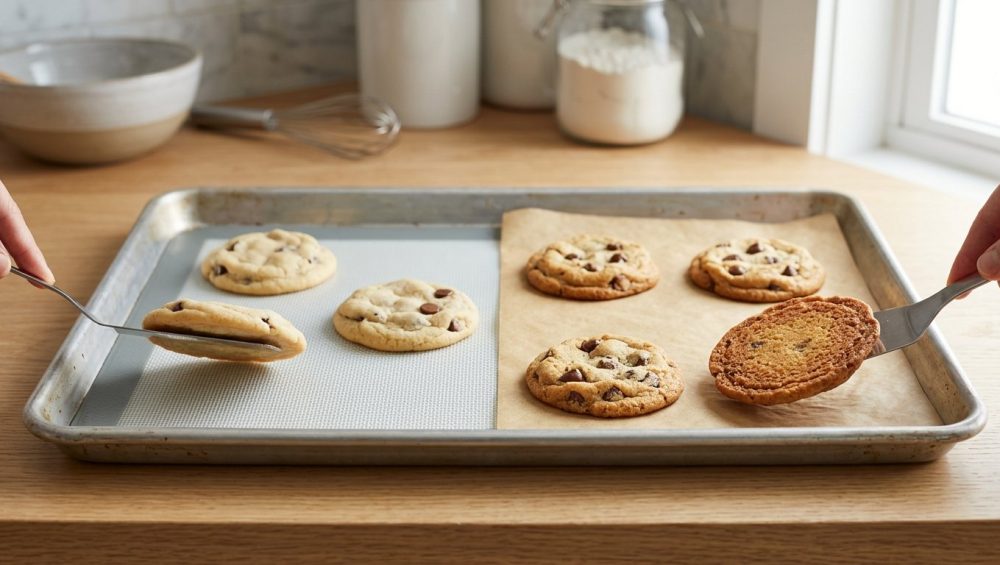
When you bake on a silicone mat, the thermal insulation delays the heat from reaching the bottom of the dough. The ambient air in the oven slowly warms the top and sides of the cookie, melting the butter. But because the bottom is insulated, the egg proteins take far too long to reach their coagulation temperature. The butter melts completely, the dough loses all its structural integrity, and the cookie spreads out into a massive, thin pancake before the flour and eggs can do their job. Much like how pancake [6] batter needs to rest to hydrate the starches properly, cookie dough relies on precise timing and temperature to hold its shape.
But the insulation is only half the problem. The other half is “The Slip.”
Silicone is engineered to be aggressively non-stick. It actually repels oils and fats. When that butter melts out of your dough, it hits the silicone and finds absolutely zero friction. There is no texture for the dough to grip onto. The melting cookie simply slip-slides across the slick surface of the mat, accelerating the spreading process. The fat pools around the edges of the dough, essentially deep-frying the outer rim of the cookie while the insulated center remains a doughy, underbaked mess.
The Maillard Reaction: The Holy Grail of Flavor
If the spreading and the greasy edges weren’t bad enough, the silicone mat commits the ultimate culinary sin: it prevents the Maillard reaction on the bottom of your cookie.
The Maillard reaction is the complex chemical process that occurs when amino acids (from the proteins in your flour and eggs) and reducing sugars are subjected to high heat. Named after the French chemist Louis Camille Maillard who first described it in 1912, this reaction is the undisputed holy grail of cooking. It is the reason a seared steak tastes better than a boiled one. It is the reason bread crust is golden and delicious. And it is the reason the bottom of a perfect chocolate chip cookie has that deeply complex, caramelized, nutty, toffee-like flavor and a satisfying crunch.
The Maillard reaction does not happen at low temperatures. It requires a rapid, intense burst of heat, typically kicking in between 280°F and 330°F (140°C to 165°C).
Because your silicone mat is a thermal insulator, the bottom of your cookie will struggle to ever reach this critical temperature window during a standard 10-to-12-minute bake. The ambient heat of the oven will eventually brown the top and edges of the cookie, but the insulated bottom will remain pale, blonde, and completely devoid of that complex Maillard flavor. Instead of a satisfying, crispy base that yields to a chewy center, you get a uniform, flabby, homogenous texture that tastes like raw flour and unbaked sugar.
The “No-Go” Rule: When Silicone Becomes Toxic Trash
Now, we need to pause for a second, because if you’ve been following my crusade on [7] banishing toxic kitchen gear, you know I have zero tolerance for cheap mystery materials melting into our food. We have a strict “No-Go” rule when it comes to degraded, low-quality kitchenware, and silicone baking mats are some of the worst offenders on the market.
While authentic, professional-grade Silpat mats are made from highly stable, platinum-cured, food-grade silicone, the market is currently flooded with cheap, knock-off mats manufactured with unregulated chemical fillers. These fillers severely compromise the thermal stability of the mat.
How do you know if your mat is full of cheap fillers? Do the pinch test. Tightly pinch a fold of the silicone mat and twist it. If the color turns stark white at the crease, you are looking at chemical fillers. Pure silicone retains its color when stretched or twisted.
These cheap fillers are not just a performance issue; they are a health hazard. When exposed to oven temperatures, these degraded mats begin to off-gas and break down. Have you ever wondered why your [8] silicone spatulas taste like soap after a run through the dishwasher, or why your cookies suddenly have a bizarre, chemical, floral undertone? That is the silicone degrading and absorbing the volatile compounds from your dish detergent and oven environment, only to release them directly into the fats of your cookie dough.
Furthermore, silicone has a strict temperature ceiling. Even the highest-quality mats max out around 480°F (250°C), while cheaper mats begin to physically degrade at just 400°F. If you have ever accidentally broiled a silicone mat, or if your mat has developed a permanent sticky, tacky film that won’t wash off no matter how much you scrub, it is dead. The polymer chains have broken down. Just like cheap skillets [9] losing their slip after a month of use, degraded baking mats become a sticky, greasy nightmare that will permanently ruin the flavor of your food.
If your favorite skillet [10] lost its non-stick properties, you wouldn’t keep using it—so why are you holding onto a greasy, stained, foul-smelling baking mat? Throw it in the trash. It is doing your food, and your health, zero favors.
The Ultimate Swap: Why Parchment Paper Reigns Supreme
So, if silicone is out, how do we achieve that perfect, bakery-style cookie at home? How do we get the non-stick convenience without the thermal insulation?
The answer is the undisputed champion of the professional pastry kitchen: parchment paper.
Parchment paper is simply paper that has been treated with an ultra-thin layer of silicone to make it non-stick and heat-resistant. But unlike a heavy, thick silicone baking mat, parchment paper offers three massive, scientifically proven advantages for drop cookies.
1. Zero Thermal Interference
Parchment paper is microscopic in thickness. It has virtually no thermal mass and provides zero insulation. When you place a piece of parchment on your aluminum baking sheet, the heat from the metal transfers instantly and aggressively straight through the paper and into the bottom of your cookie dough. The butter melts, but the egg proteins coagulate just as fast, locking the cookie into a thick, beautiful dome. The bottom of the cookie rapidly reaches the 300°F threshold, triggering a glorious Maillard reaction that results in a deeply browned, crispy, perfectly caramelized base.
2. The Micro-Grip Factor
While parchment is non-stick enough to ensure your cookies release easily from the pan, it is not aggressively slippery like a rubber mat. Parchment paper has a microscopic fibrous texture. When the dough begins to bake and expand, it actually grips the subtle texture of the paper. Instead of sliding outward into a flat puddle, the dough uses that friction to climb upward, resulting in a significantly thicker, more substantial cookie.
3. Fat Absorption
Unlike silicone, which actively repels oil and causes butter to pool around the edges of your dough, parchment paper is ever-so-slightly porous. It absorbs and wicks away the excess fat that leaches out during the first few minutes of baking. This prevents the edges of your cookies from deep-frying in their own butter, ensuring a clean, even bake from edge to center.
Addressing the Eco-Guilt
I know what you are thinking. “But Sassy Sous-Chef, I bought the silicone mat because I wanted to be environmentally friendly! I hate throwing away single-use parchment paper!”
I hear you, and I respect the intention. But the idea that parchment paper is strictly “single-use” is a myth perpetuated by the people trying to sell you silicone mats. High-quality, unbleached parchment paper is incredibly durable. If you are doing a massive weekend baking project, you can absolutely reuse the exact same sheet of parchment paper for four, five, or even six consecutive batches of cookies. As long as the paper isn’t burnt to a crisp or completely saturated in grease, just slide the baked cookies off, let the pan cool, and drop your next batch of dough right onto the same sheet.
When we talk about weekday efficiency, time is money. A silicone mat requires you to haul it to the sink, aggressively scrub it with hot soapy water to cut the grease, figure out a way to dry a floppy, awkward sheet of rubber, and carefully roll it up for storage. With parchment paper, you bake your cookies, wipe down your aluminum pan, and toss the paper into your compost bin. Zero clean-up, zero stress, and infinitely better food.
Pro-Level Cookie Troubleshooting Guide
While ditching the silicone mat is the single biggest upgrade you can make to your cookie game, it is not the only variable in the kitchen. If you have swapped to parchment paper and heavy-duty aluminum pans but are still struggling with flat, sad cookies, you need to audit your technique. Here are the three non-negotiable rules for a perfect bake:
1. Respect the Chill
If a recipe tells you to chill your cookie dough for 24 hours, do not ignore it. Chilling dough is not just about flavor development (though allowing the flour to fully hydrate makes a massive difference in taste). It is about thermal control. When you chill dough, you solidify the butter. Cold butter takes significantly longer to melt in the oven, which buys the egg proteins more time to set the structure before the cookie spreads. If your kitchen is 80 degrees and your dough is warm and greasy before it even hits the oven, it is going to turn into a puddle, regardless of what you bake it on.
2. Calibrate Your Oven
Your oven is lying to you. When the digital display beeps and says it has reached 350°F, it is probably hovering somewhere around 315°F. Ovens cycle heat on and off, and most home ovens are wildly inaccurate. If your oven is running cold, your cookies will spread before they bake. Buy a cheap, analog stainless steel oven thermometer, hang it directly on the center rack, and trust what it says over the digital display.
3. Ditch the Measuring Cups
Baking is a science, and volume measurements (like cups) are the enemy of scientific accuracy. A “cup” of flour can weigh anywhere from 100 grams to 150 grams depending on how aggressively you scooped it out of the bag. If you are shorting your dough by 50 grams of flour, your cookies will lack the structural starches needed to hold their shape, resulting in excessive spreading. Buy a digital kitchen scale. Measure your ingredients in grams. It is faster, cleaner, and guarantees consistent results every single time.
When Should You Actually Use a Silicone Mat?
I am not telling you to take your expensive, authentic, platinum-cured Silpat out to the backyard and set it on fire. Silicone mats are brilliant, highly specialized tools—you just have to use them for their intended purpose.
Keep your high-quality silicone mats rolled up in your drawer for the projects where their unique properties are actually an asset:
- Macarons: Macaron batter is incredibly delicate and sticky. The insulation of a silicone mat actually helps prevent the bottoms of the delicate almond meringue shells from browning too quickly, which is a desirable trait for macarons.
- Candy Making: If you are pouring boiling hot sugar to make peanut brittle, toffee, or caramel, a silicone mat is a lifesaver. The sugar will never stick, and the mat can easily handle the heat of the cooling candy.
- Sticky Dough Prep: Use your silicone mat on your kitchen island as a non-stick work surface for kneading highly hydrated bread doughs, rolling out pie crusts, or shaping sticky brioche.
- Freezing: Silicone mats are fantastic for lining sheet pans when you want to individually quick-freeze berries, dumplings, or balls of cookie dough before transferring them to a storage bag.
Just keep them far, far away from your oven when it is time to bake a batch of drop cookies.
Conclusion: Reclaiming Your Weekend Bake
You do not need a culinary degree to make mind-blowing food. You do not need a kitchen outfitted with thousands of dollars of commercial equipment. You just need to understand the basic, unpretentious science of how heat interacts with your ingredients.
The next time you decide to tackle a weekend baking project, leave the rubber mats in the drawer. Grab a heavy-duty aluminum half-sheet pan, lay down a single, crisp sheet of parchment paper, and let the thermodynamics do the heavy lifting. You will be rewarded with cookies that boast a beautifully caramelized, crispy base, a delightfully thick and chewy center, and the undeniable satisfaction of knowing exactly how you achieved it.
Now, stop reading, go preheat your oven (and check your analog thermometer!), and get baking. You’ve got this.