We have all been there. It is a random Tuesday night, you are exhausted from back-to-back meetings, and you just want a simple bowl of rigatoni. You get the water boiling, drop in the pasta, and turn your back for exactly four seconds to chop some garlic. Suddenly, you hear that unmistakable, soul-crushing hiss. You whip around to see a violently frothing, starchy volcano erupting over the sides of your pot, cascading down the sides of your stove, and instantly baking into a cement-like crust on your burners. Congratulations, your quick weeknight dinner just earned you thirty minutes of aggressive scrubbing.
As a home cook who has set off the smoke detector more times than I care to admit, I can tell you that this exact scenario used to be the bane of my existence. But here is the good news: you do not need a culinary degree to stop this from happening. You just need a basic understanding of kitchen physics, a refusal to use terrible cookware, and a few clever tricks up your sleeve. We are going to dive deep into exactly why your pasta pot turns into a science fair volcano, and more importantly, how to stop it dead in its tracks. No pretentious chef-speak, no useless fluff—just brutally effective strategies so you can get back to cooking.
The Science of the Spill: Why Pasta Water Turns into a Volcano
Before we can defeat the enemy, we must understand the enemy. Boiling plain water is a relatively peaceful process. The heat source transfers energy to the water, turning it into steam. That steam forms bubbles at the bottom of the pot, which rise to the surface, burst instantly, and release their vapor into the air. It is predictable, manageable, and frankly, a little boring. But the moment you drop dried or fresh pasta into that rolling boil, you fundamentally change the chemical composition of the water.
Starch Gelatinization Explained (Without the Pretentious Chef-Speak)
Pasta is essentially a dense matrix of carbohydrates, primarily composed of two types of starch molecules: amylose and amylopectin. When these tightly packed starches are exposed to rapidly boiling water, they undergo a process called gelatinization. The hot water penetrates the pasta dough, causing the starch granules to swell massively. Eventually, these granules burst open, releasing long, sticky chains of starch directly into your cooking water.
Modern food science research, including studies published in journals like the Journal of Culinary Science & Technology, has shown that when the starch concentration in your boiling water surpasses 0.8% weight by volume, the physical properties of the liquid change dramatically. The water becomes slightly more viscous, thicker, and significantly more prone to trapping gases. This starchy liquid is actually culinary gold when it comes time to build a cohesive, glossy pan sauce, which is why understanding the magic of starchy water is so crucial for elevating your meals. However, while your pasta is still boiling, that same starch is actively plotting to destroy your clean stovetop.
The Role of Surface Tension and Foaming
The real culprit behind the boil-over is surface tension combined with thermal insulation. In plain water, a bubble’s surface tension is relatively weak, so it pops the millisecond it hits the air. But when water is heavily laced with dissolved pasta starches, those starch molecules align themselves along the walls of the bubbles. This acts as a structural reinforcement, reducing the surface tension just enough to make the bubbles incredibly elastic and resilient.
Instead of popping, these starchy bubbles stretch, hold their shape, and begin to stack on top of one another. As thousands of these reinforced bubbles accumulate, they create a thick, stable layer of foam across the top of your pot. This foam acts as a thermal blanket, trapping the intense steam and vapor pressure trying to escape from the boiling water below. The heat has nowhere to go, the pressure builds exponentially, and the entire mass of foam surges upward in a matter of seconds. It is not just boiling over; it is an explosive release of trapped thermal energy.
Why the Shape and Type of Pasta Matters
Not all pasta will betray you equally. If you are cooking a standard, smooth-textured, mass-produced spaghetti, you might only see a moderate amount of foam. But if you are a weekend culinary hobbyist who splurges on high-quality, bronze-die extruded artisanal pasta, you need to be on high alert.
Bronze-die pasta has a deliberately rough, porous surface designed to grip sauces perfectly. That same rough texture means a significantly higher amount of surface starch is immediately washed off into the water the second it hits the pot. Furthermore, if you are cooking fresh homemade egg pasta, the combination of raw flour dusting and the lack of a dried, hardened exterior means starch gelatinization happens almost instantaneously. The foam will rise faster and thicker than you can imagine. Knowing your ingredients is the first step in surviving kitchen disasters without losing your mind or ruining your stove.
The Legendary Wooden Spoon Hack: Fact, Fiction, or Witchcraft?
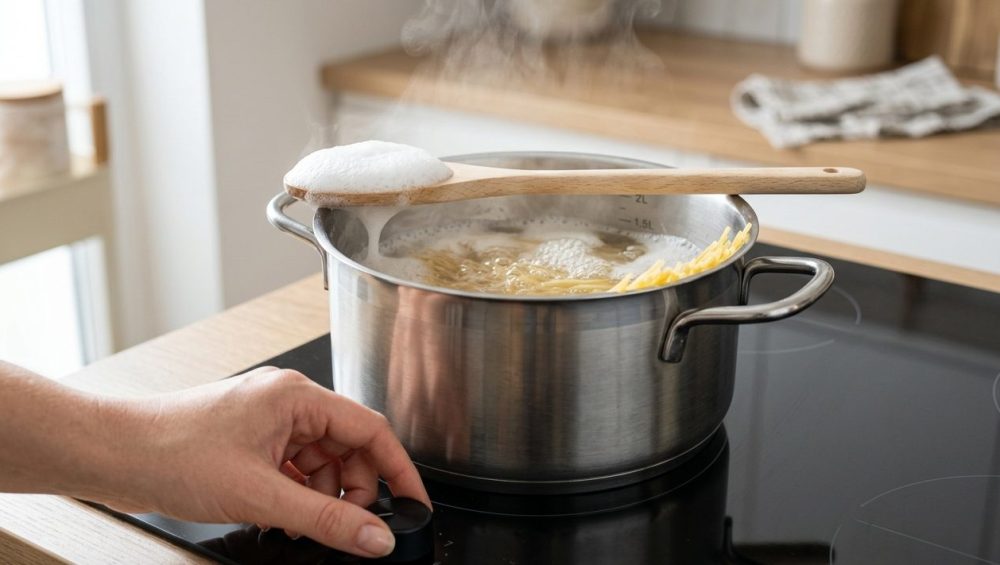
If you have spent any time on the internet or watched a grandmother cook, you have likely seen the famous wooden spoon trick. You place a dry wooden spoon horizontally across the rim of your boiling pot, and miraculously, the surging foam hits the spoon and retreats like a defeated army. It looks like kitchen witchcraft, but it is actually a beautiful display of fluid dynamics and interfacial thermodynamics.
How It Actually Works: Interfacial Thermodynamics
The wooden spoon trick is not folklore; it is physics in action. When the vigorously boiling, viscous, starch-laden foam rises to the top of the pot, it eventually makes contact with the wooden spoon. Wood, by its very nature, is a fantastic insulator. It does not conduct heat quickly, meaning the spoon remains significantly cooler than the 212°F (100°C) boiling water and steam.
When the hot, steam-filled bubbles touch the cooler surface of the wood, the steam inside the bubbles instantly condenses back into liquid water. This sudden drop in internal pressure causes the bubble to collapse. Furthermore, untreated wood is highly hydrophilic (water-attracting) and porous. It introduces a heterogeneous nucleation site. The cellulose fibers of the wood physically disrupt the bubble coalescence. Basically, the wood aggressively pulls at the moisture in the bubble’s membrane, destabilizing the surface energy and causing the foam to shatter before it can bridge the rim of the pot.
The Microscopic Roughness Factor
If you were to look at a wooden spoon under a microscope, you would see a jagged, rough, mountainous terrain of wood grain and fibers. This microscopic roughness is the secret weapon. When an elastic, starchy bubble hits that rough surface, it is forced to stretch across the jagged fibers. The stretching force quickly exceeds the reinforced surface tension holding the bubble together, and it violently pops.
This is exactly why you cannot substitute other materials. If you try this with a metal spoon, it will fail miserably. Metal is a rapid conductor of heat; within seconds, the spoon will be just as hot as the steam, eliminating the condensation effect. If you try it with a sleek silicone spatula, it will also fail. Silicone is perfectly smooth and hydrophobic (water-repelling). The foam will simply slide right over the silicone without its surface tension being disrupted. You need the cool, rough, porous nature of wood.
Why the Spoon Eventually Fails
As brilliant as the wooden spoon hack is, it is not a permanent forcefield. It has a fatal flaw: the saturation point. As the wood sits over the boiling water, it absorbs the steam and the splashing starchy liquid. Once the wood becomes fully waterlogged and heated through, it loses its capillary action, its microscopic roughness is smoothed over by moisture, and its temperature differential vanishes.
When the spoon is saturated, the foam will simply swallow it whole and boil over anyway. The spoon is not meant to let you walk away and watch television; it is a delay tactic. It buys you 60 to 90 seconds of grace period—just enough time to notice the surge, step back to the stove, and properly adjust your heat. If you are doing a long boil and rely heavily on this trick, you must swap the wet spoon for a completely dry one mid-cook.
Foolproof Heat Management: Master Your Stovetop, Master Your Life
The most effective way to stop a pot from boiling over requires zero gadgets and zero spoons. It simply requires you to stop cooking like a chaotic maniac and learn how to manage your stovetop temperatures. The vast majority of home cooks have been brainwashed into believing that pasta must be subjected to a violent, roaring boil for the entire duration of its cooking time. This is unequivocally false, and it is the primary reason you are scrubbing burnt starch off your burners.
The Rapid Boil Myth
Let us debunk one of the most pervasive culinary myths right now: you do not need a rolling boil to cook pasta. Water boils at 212°F (100°C) at sea level. Whether the water is gently bubbling or thrashing around like a tempest, the temperature of that water is exactly the same. A violent, rolling boil does not cook your pasta any faster; it merely evaporates your water faster, concentrates the starches more aggressively, and creates the perfect conditions for an uncontrollable foam surge.
The only reason you need a vigorous boil is for the first 60 seconds after you drop the pasta in. The aggressive agitation of the rapidly bubbling water prevents the pasta strands from clumping together and sticking to the bottom of the pot before the starches have a chance to set. Once that initial danger window has passed, maintaining a maximum-heat rolling boil is just asking for trouble. It is one of those classic rookie kitchen mistakes that causes unnecessary stress and messy cleanups.
The Weekday Efficiency Trick
When I am cooking on a busy weekday, time is money. I need efficiency, and I refuse to spend my evening cleaning a stove. Here is my foolproof, step-by-step heat management method for a Tuesday night pasta dinner:
First, bring your salted water to a rapid, aggressive boil over high heat. Drop your pasta in and immediately stir it continuously for about 15 to 20 seconds. This initial stir is non-negotiable; it physically separates the pasta and disrupts the initial massive release of surface starches. Wait for the water to return to a full boil. The second you see the water reach that roaring state again, immediately dial your burner down to medium or medium-low.
You are looking to maintain a gentle, steady simmer. The water should be bubbling enough to keep the pasta moving slightly, but not so violently that foam begins to stack. By lowering the heat, you reduce the rate of vapor production, which means less steam is getting trapped beneath the starchy surface layer. The pasta will cook perfectly in the exact same amount of time, but your stove will remain spotless. Mastering this simple temperature control is a massive step toward establishing a peaceful daily habit in your kitchen, rather than a frantic race against overflowing pots.
Oil in the Pasta Water: A Culinary Sin or a Clever Trick?
If you ask a random person how to stop pasta from boiling over, there is a very high chance they will tell you to pour a glug of olive oil into the boiling water. If you ask an Italian grandmother the same question, she will likely chase you out of her kitchen with a rolling pin. The great oil debate is one of the most polarizing topics in home cooking, and we need to address the science—and the culinary tragedy—behind it.
The Surface Tension Argument
From a purely physics-based standpoint, the people who advocate for adding oil are not entirely wrong. Oil is a lipid, and lipids are incredibly effective at disrupting surface tension. When you add a layer of oil to your boiling starchy water, the oil droplets intersperse with the starch molecules. Because oil and water do not mix, the oil creates weak points in the bubble membranes.
When the starchy foam tries to rise and stack, the oil physically prevents the bubbles from forming a stable, cohesive structure. The foam breaks apart almost instantly, and the risk of a boil-over is drastically reduced. It is a highly effective scientific mechanism. But just because you can do something does not mean you should.
Why Italians Will Cry If You Do This
Adding oil to your pasta water is a culinary sin of the highest order. Yes, it stops the foam, but it ruins the actual meal. When you drain your pasta, that layer of oil coating the surface of the water drops down and coats every single strand of your spaghetti, penne, or rigatoni. You have just waterproofed your pasta.
When you subsequently add your beautifully simmered marinara, rich bolognese, or delicate white wine sauce, the sauce will hit the oil slick on the pasta and slide right off. Instead of a cohesive, restaurant-quality dish where the sauce clings lovingly to the noodles, you will end up with a sad, naked pile of pasta sitting in a watery puddle of sauce at the bottom of your bowl. We do not spend our weekends perfecting complex sauces only to sabotage them at the finish line. There are far better ways to control a pot than ruining the fundamental texture of your food.
Pot Size and Cookware Quality: Stop Sabotaging Yourself with Bad Gear
Sometimes, the reason your pot boils over has nothing to do with your technique and everything to do with the fact that you are using the wrong equipment. I am a firm believer that you cannot do a good job with bad tools. If you are constantly battling overflowing pots, it is time to take a hard look at the vessel you are cooking in.
The “Headroom” Rule for Pasta Pots
For decades, conventional wisdom dictated that you needed a massive, 8-quart stockpot filled to the brim with water to cook a single pound of pasta. This is a complete myth. You can absolutely cook a pound of pasta in a smaller volume of water—in fact, doing so creates a wonderfully starchy liquid that is perfect for sauce emulsification. However, the critical factor is not the total volume of water, but the amount of headroom you leave in the pot.
Headroom is the empty space between the surface of the water and the rim of the pot. If you take a 4-quart saucepan and fill it 90% full with water, it is going to boil over the second the starch hits it. The foam has zero distance to travel before it breaches the rim. As a strict rule, you should never fill any pot more than two-thirds to three-quarters full when boiling pasta. You must leave at least three to four inches of vertical empty space. This gap acts as a buffer zone, giving the foam room to rise and expand while giving you enough time to react and turn down the heat before it hits the stove.
The Toxic Cookware Rant
This brings me to one of my absolute non-negotiables: the quality of your cookware. I have zero patience for cheap, lightweight, toxic kitchenware. If you are currently boiling your pasta in a flimsy, $15 aluminum pot coated in a mystery non-stick material that has been peeling and flaking into your food since 2022, we need to have a serious intervention.
Not only are these cheap non-stick pots a massive health hazard, but they are also terrible at heat distribution. Flimsy pots develop aggressive hot spots directly over the burner flames. These localized zones of extreme heat cause the water to boil violently and unpredictably in certain areas, leading to sudden, explosive surges of foam that you cannot control.
You need to invest in serious, safe, heavy-duty gear. Multi-clad stainless steel or enameled cast iron should be your standard. A high-quality, fully clad stainless steel pot has a core of aluminum or copper sandwiched between layers of surgical-grade steel. This construction conducts heat evenly across the entire base and up the sides of the pot. The water boils uniformly, the thermal energy is distributed smoothly, and you do not get those violent, localized eruptions. Upgrading your pots is a critical step in banishing toxic kitchen gear from your home and instantly improving your control over the cooking process. You do not need fifty pots; you just need a few good ones. Finding the right heavy-duty pot is one of the most important beginner cooking essentials you can acquire.
Advanced Tactics: Unconventional Hacks for the Weekend Perfectionist
For the weekend culinary hobbyist who wants to exert absolute control over their kitchen environment, the standard tricks might not be enough. If you are pushing the limits of starch concentration for a highly specific recipe, you need advanced tactics. These are the unconventional methods that go beyond the wooden spoon and basic heat management.
The Butter Rub Trick
This is an old-school restaurant trick that relies on the exact same surface-tension-breaking principles as the oil method, but without ruining the pasta itself. Take a cold stick of butter (or a paper towel dipped in a tiny amount of neutral oil) and physically rub a thin ring around the inside rim of your pot, about an inch or two above the waterline, before you turn on the heat.
As the starchy foam rises up the sides of the pot, it eventually hits this invisible hydrophobic barrier. Because the lipid barrier is anchored to the metal rather than floating freely in the water, it aggressively repels the water molecules in the foam. The bubbles reach the butter line, their surface tension is shattered by the fat, and the foam collapses back down into the pot. Because the amount of butter used is microscopic and stays on the rim, it does not coat your pasta or interfere with your sauce adhesion. It is brilliant, invisible, and highly effective.
The Frying Pan Method
If you want to completely eliminate the risk of a vertical boil-over while simultaneously creating the most luxurious, starch-heavy pasta water imaginable, you need to abandon the pot entirely. Enter the frying pan method.
Instead of boiling a deep column of water, place your dried pasta flat in a wide, high-sided stainless steel skillet. Add just enough cold water to cover the pasta by about half an inch. Turn the heat to medium-high and let it cook, stirring frequently. Because the water is shallow and the surface area is massive, the water evaporates quickly, and the starch concentration becomes incredibly dense.
However, because the skillet is so wide, the bubbles have infinite room to spread out horizontally rather than stacking vertically. The foam simply cannot build enough structural integrity to climb the short walls of the skillet. This technique is an absolute game-changer, especially when making dishes like Cacio e Pepe that require an intense starch emulsion. Utilizing the frying pan pasta trick will fundamentally change how you view weeknight cooking.
The Ice Cube Drop
Sometimes, despite all your best intentions, you get distracted. You look over, and the foam is one millimeter away from breaching the rim. You do not have time to grab a wooden spoon, and turning the dial down on an electric or glass-top stove takes too long to dissipate the residual heat. You need an instant panic button.
Keep a small bowl of ice cubes near your prep station. If the pot surges, drop a single ice cube directly into the center of the foam. The extreme, localized drop in temperature instantly shatters the thermal blanket of the foam. The steam inside the bubbles condenses in a fraction of a second, and the entire mass collapses instantly. It is a violent, immediate correction that buys you the time you need to move the pot off the hot burner. It barely affects the overall cooking time of the pasta, but it will absolutely save your stovetop.
Cleaning Up the Mess (Because You Probably Forgot to Watch the Pot Again)
Look, I am a realist. Even with the best knowledge in the world, we are human. You are going to get a text message, or the dog is going to bark, and you are going to let a pot boil over. When it happens, the cleanup protocol is just as important as the prevention.
Tackling Burnt Starch on the Stove
If you have a gas stove with removable grates, a boil-over is annoying but manageable. You take the grates to the sink and scrub them. But if you have a modern, flat glass-top induction or electric stove, starchy pasta water is your worst nightmare. When that highly concentrated carbohydrate liquid hits the 400-degree glass surface, the water evaporates instantly, leaving behind a carbonized, cement-like layer of pure burnt starch.
Do not reach for highly abrasive, toxic chemical sprays, and absolutely do not use steel wool, which will permanently scratch the glass. Instead, rely on simple chemistry. While the stove is completely cool, make a thick paste of baking soda and warm water. Smear it generously over the burnt starch stains. Lay a hot, damp microfiber cloth over the paste and let it sit for at least twenty minutes. The alkaline nature of the baking soda combined with the moisture will soften and break down the carbonized bonds.
After twenty minutes, remove the cloth and use a specialized razor scraper (designed specifically for glass stoves) held at a shallow 45-degree angle to gently glide under the softened starch. It will peel off in satisfying ribbons. Having a good scraper on hand is one of those underrated beginner kitchen tools that you will thank yourself for buying every single week.
Preventative Maintenance
The true secret to a clean kitchen is addressing messes the second they happen, not the next morning. If a pot boils over, do not let the starch bake onto the surface for the next hour while you eat dinner. Carefully move the pot to a cool burner. Take a damp, thick towel and quickly wipe up the liquid pool while the stove is still warm (but not dangerously hot). The longer starch sits on a heat source, the harder it becomes to remove. Developing the reflex to clean as you go is the ultimate way to cure cooking anxiety and keep your kitchen an inviting space rather than a chore zone.
Final Thoughts: Reclaim Your Kitchen and Your Sanity
Cooking should be an empowering, creative outlet, not a constant, stressful battle against the laws of physics. A boiling pot of pasta water is not a wild, untamable beast; it is just a simple chemical reaction involving heat, water, and carbohydrates. Once you understand the mechanics of starch gelatinization and surface tension, you hold all the cards.
Whether you choose to employ the heterogeneous nucleation of a dry wooden spoon, the thermal mastery of proper heat management, or the hydrophobic barrier of a buttered rim, the goal is the same: absolute control. Stop accepting messy stovetops as a normal part of making dinner. Throw away your cheap, hot-spot-prone cookware, stop boiling your water on maximum heat for twenty minutes, and start cooking with intention.
You have the knowledge, you have the techniques, and you have the power to make mind-blowing food without the mind-numbing cleanup. Mastering these small, seemingly insignificant details is exactly what separates the frustrated amateur from the confident home cook. It is the very foundation of the art of effortless hosting and the key to enjoying your time in the kitchen. Now go boil some water, drop in that pasta, and watch with smug satisfaction as the foam stays exactly where it belongs. You’ve got this.